Chapter 1
The short answer: sell the bundle logic before the bundle price
To plan social content for a product bundle launch, start by defining the complete outcome the bundle creates. Then create content that explains the problem, introduces each item as part of the solution, proves the items work together, answers objections, and promotes the launch offer. Price matters, but only after the buyer understands why the bundle exists.
Shopify supports product bundling through product and discount workflows, but social content has to do the buyer-facing explanation. A customer should not feel like you grouped random products to raise average order value. They should feel like the bundle saves them time, improves a routine, completes a look, solves a full problem, or makes a gift easier.
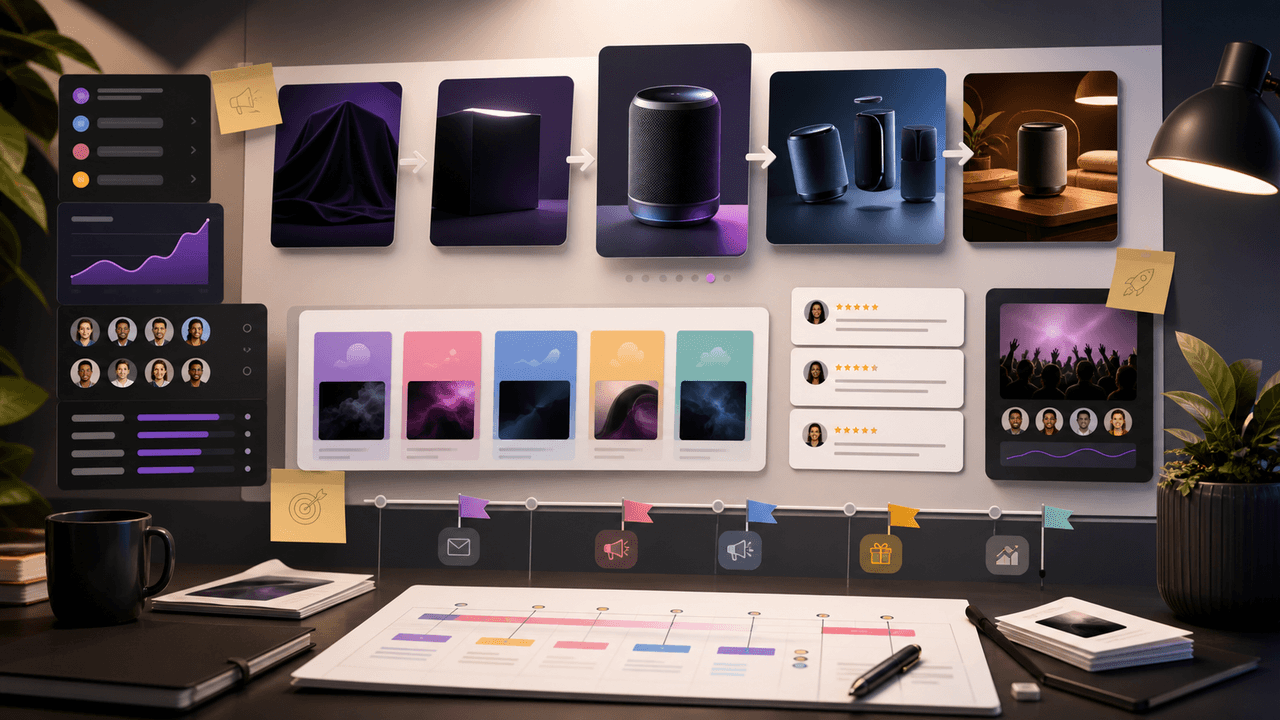
The best bundle launch system uses multiple formats. Instagram carousels explain the bundle logic. TikTok slideshows show the bundle in use. Stories handle urgency and Q&A. Email or product-page sections carry the direct offer. One bundle angle becomes a campaign, not one post.
Lead with the complete outcome, not the item list.
Give each product a role in the bundle.
Show the bundle together and in use.
Explain savings, convenience, giftability, routine fit, or launch urgency honestly.
Send traffic directly to the bundle page or exact product set.
Chapter 2
Choose the bundle's positioning before choosing formats
A bundle launch can be positioned in several ways: complete routine, starter kit, gift set, seasonal set, upgrade kit, replenishment pack, travel kit, problem-solution set, or limited launch bundle. The position determines the content strategy.
For example, a skincare starter kit should teach routine order and ingredient compatibility. A coffee gift bundle should show giftability, packaging, flavor variety, and deadline. A desk setup bundle should show before-after workspace improvement and why each item belongs.
The bundle name should make the promise obvious. 'Summer Reset Kit' is more useful than 'Bundle 03' if the content can show what summer problem it solves. Avoid names that sound creative internally but mean nothing to the buyer.
- 1
Name the buyer problem
What complete problem does this bundle solve better than a single product?
- 2
Assign item roles
Every item should have a job: first step, finishing step, backup, refill, gift anchor, accessory, or proof component.
- 3
Choose the value angle
Is the value savings, convenience, routine success, limited availability, giftability, or expert curation?
- 4
Define the launch CTA
Use one destination: bundle page, collection page, TikTok Shop product, preorder, or launch waitlist.
Chapter 3
Instagram carousel structure for a bundle launch
Instagram carousels are ideal for explaining bundle logic because each slide can assign a role, answer an objection, or show a comparison. The buyer should finish the carousel understanding why the bundle is easier than building the set themselves.
Use a 7 to 9 slide structure. The first slide names the outcome. The middle slides explain the problem and each item role. The final slides show the bundle together, the value comparison, and the CTA.
Do not hide the products behind excessive design. Bundle launches need visual clarity: all items together, each item separately, the use sequence, and a final offer slide that matches the landing page.
- 1
Slide 1: Complete outcome hook
Example: 'The 4-piece weekend travel kit that keeps your routine under 10 minutes.'
- 2
Slide 2: The old way
Show the scattered, incomplete, expensive, or confusing version of solving the problem.
- 3
Slides 3-6: Item roles
Explain one item per slide and connect each item to the complete outcome.
- 4
Slide 7: Bundle together
Show the full set, packaging, value, and how the items relate.
- 5
Slide 8: Objection or proof
Answer size, compatibility, routine time, shipping, or value questions.
- 6
Slide 9: Launch CTA
Send people to the exact bundle page with the launch offer clearly stated.
Chapter 4
TikTok slideshow structure for a bundle launch
TikTok slideshows should show the bundle story faster. Instead of explaining every detail, they should make the bundle feel obvious through sequence: messy old state, bundle reveal, item roles, final outcome, offer.
Use strong vertical compositions. The full bundle should appear early, then the sequence can zoom into each item. If the bundle is a routine, show the steps in order. If it is a gift, show packaging and recipient moment. If it is a seasonal set, show the situation where it becomes useful.
The first test should use three hooks: problem-led, outcome-led, and value-led. Keep the middle sequence the same so you can learn which launch angle is strongest.
Problem-led hook: 'Stop packing five random bottles for every weekend trip.'
Outcome-led hook: 'A complete morning routine that fits in one pouch.'
Value-led hook: 'The bundle is cheaper than buying these four separately.'
Gift-led hook: 'The no-guesswork gift for someone who loves coffee at home.'
Urgency-led hook: 'Launch week: the first 300 sets include the travel case.'
Chapter 5
Build proof around the bundle's weak points
Bundles often create predictable objections. Buyers wonder whether they need every item, whether the savings are real, whether the items work together, whether the bundle is customizable, and whether it is still a good deal if they already own one item.
Make those objections part of the launch content. A comparison carousel can show individual total versus bundle price. A routine slideshow can show how the items work together. A FAQ story can answer substitution, return, gift, and shipping questions. A review post can show a customer using the set as intended.
Be careful with savings claims. If you compare prices, make the comparison accurate and current. If the offer is limited, the limitation should be real. Trust matters more than urgency theater.
Objection: 'I do not need every item.' Answer with item roles and use sequence.
Objection: 'Is the discount real?' Answer with transparent individual total and bundle price.
Objection: 'Will this fit my routine?' Answer with time, steps, and use context.
Objection: 'Can I gift this?' Answer with packaging, recipient type, and shipping deadline.
Objection: 'Which variant should I choose?' Answer with a variant chooser carousel.
Chapter 6
A 14-day social content calendar for bundle launch week
A bundle launch needs buildup before the offer and support after launch day. Use the first week to teach the problem and prepare the buyer. Use launch week to reveal the bundle, prove value, handle objections, and keep the offer visible.
This calendar assumes one main feed asset every weekday plus stories. Smaller teams can compress it to six strong assets: teaser, problem, bundle reveal, item roles, proof, and final offer.
- 1
Day -7: Problem carousel
Explain the problem the bundle solves without announcing the full offer yet.
- 2
Day -5: Item education
Teach one product or ingredient/material that will later appear in the bundle.
- 3
Day -3: Behind-the-scenes or curation logic
Explain why these items belong together.
- 4
Day -1: Launch teaser slideshow
Show the bundle silhouette, packaging, or result with a clear launch time.
- 5
Day 0: Bundle reveal carousel
Publish the full bundle structure, value, deadline, and CTA.
- 6
Day 2: TikTok product-in-use slideshow
Show the bundle solving the complete problem in a fast sequence.
- 7
Day 4: Objection FAQ carousel
Answer the top buying questions from comments, DMs, and product page behavior.
- 8
Day 7: Final offer reminder
Recap who the bundle is for and why the launch offer ends.
Chapter 7
Measure bundle content by average order value and clarity
Bundle launches should affect more than engagement. Track bundle page visits, add-to-cart rate, bundle conversion rate, average order value, variant selection, use of discount, and customer questions. If the content works, buyers should need less explanation by the time they reach the page.
Also track confusion. If comments keep asking what is included, the reveal carousel is unclear. If people ask whether items can be bought separately, the item-role slides may need a clearer value explanation. If people click but do not add to cart, the landing page may not continue the social promise.
After launch, turn the best-performing bundle content into evergreen assets: product-page modules, collection banners, paid creative, email flows, and future seasonal bundle templates.
Traffic: bundle page visits, product taps, link clicks, and TikTok Shop taps.
Conversion: add-to-cart, checkout start, purchase, discount use, and revenue.
Value: average order value, units per order, and bundle attach rate.
Clarity: repeat questions, variant confusion, and support tickets.
Reuse: number of assets that become evergreen product education.
Callout
Where AttentionClaw fits in a bundle launch
AttentionClaw helps ecommerce teams turn bundle strategy into Instagram carousels, TikTok slideshows, and launch-week content that stays visually consistent.
Next step
Turn a bundle launch plan into scheduled social creative
AttentionClaw helps ecommerce teams generate product bundle carousels, TikTok slideshows, offer posts, and launch-week content from one campaign brief.
Common Questions
FAQ
More Reading
Keep reading
8-chapter read
Boutique Product Drop Instagram Carousels
Boutique product drop carousels should show new arrivals, fit and material details, care information, inventory timing, review proof, and shopping CTAs without misleading scarcity or labeling claims.
9-chapter read
Ecommerce Subscription Retention Instagram Carousels: Reduce Churn With Better Education
Ecommerce subscription retention carousels should help subscribers use the product, understand billing and cancellation choices, skip or swap correctly, and see why the next shipment matters.
8-chapter read
Carousel Slide Order That Converts: Hook, Proof, Offer, CTA
A converting carousel usually follows a clear order: hook, context, problem, solution or product, proof, objection handling, offer, and CTA. The exact slide count can change, but the reader should never wonder why the next slide exists.
7-chapter read
Instagram Carousel Ad Hook Formulas That Qualify Buyers
The best Instagram carousel ad hooks qualify the audience, name the buying problem, and create a reason to swipe. A hook should attract the right buyer, not just the most curious viewer.
7-chapter read
How to Turn a Product Detail Page Into Social Content
A product detail page can become a full social campaign when you extract buyer questions, benefits, proof, variants, objections, reviews, and offers. The goal is not to copy the page into posts; it is to turn each product-page section into one useful social asset.
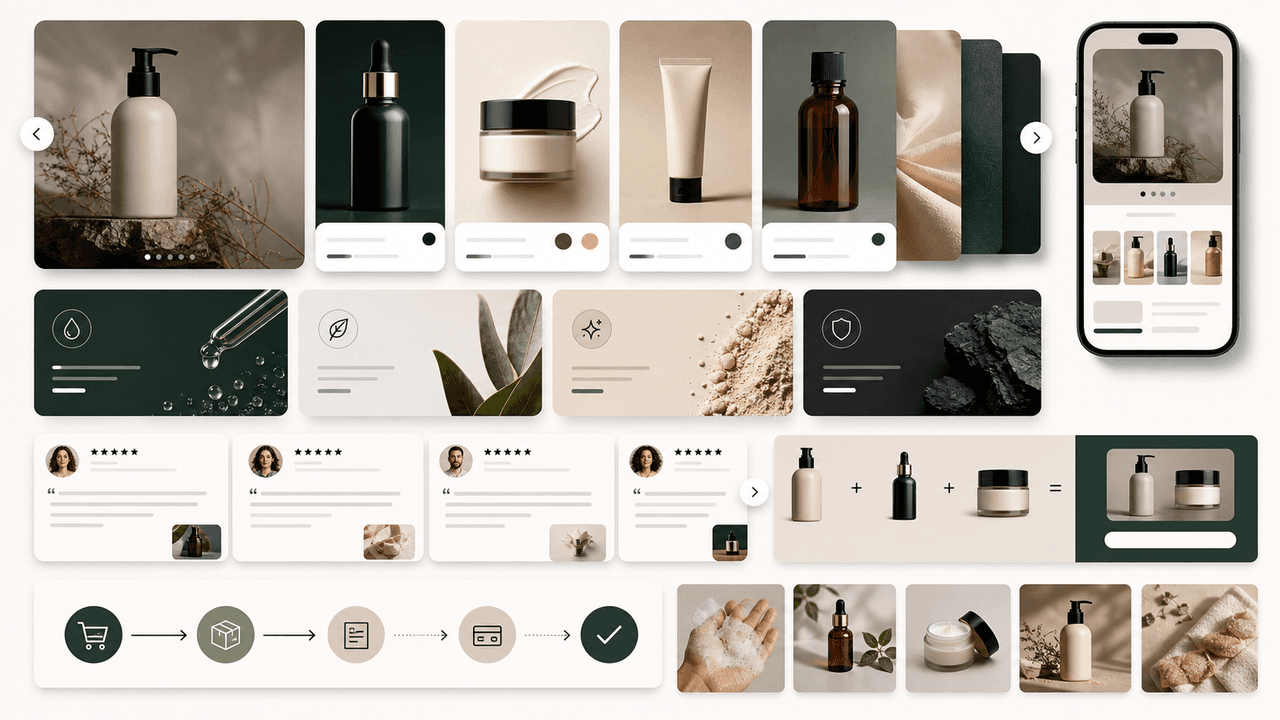
Build one product launch carousel people can verify
An Instagram product launch carousel should explain what changed, who it is for, what evidence supports the promise, what the offer includes, and where to act. This guide provides the brief, asset gate, full sequence, and measurement plan.
Four Product Carousel Formats Built Around Evidence
The best ecommerce carousel template depends on the buyer question and the evidence available. These four formats organize approved product details, media, comparison facts, bundle contents, and use cases into reviewable slide sequences without promising that a template will generate sales.
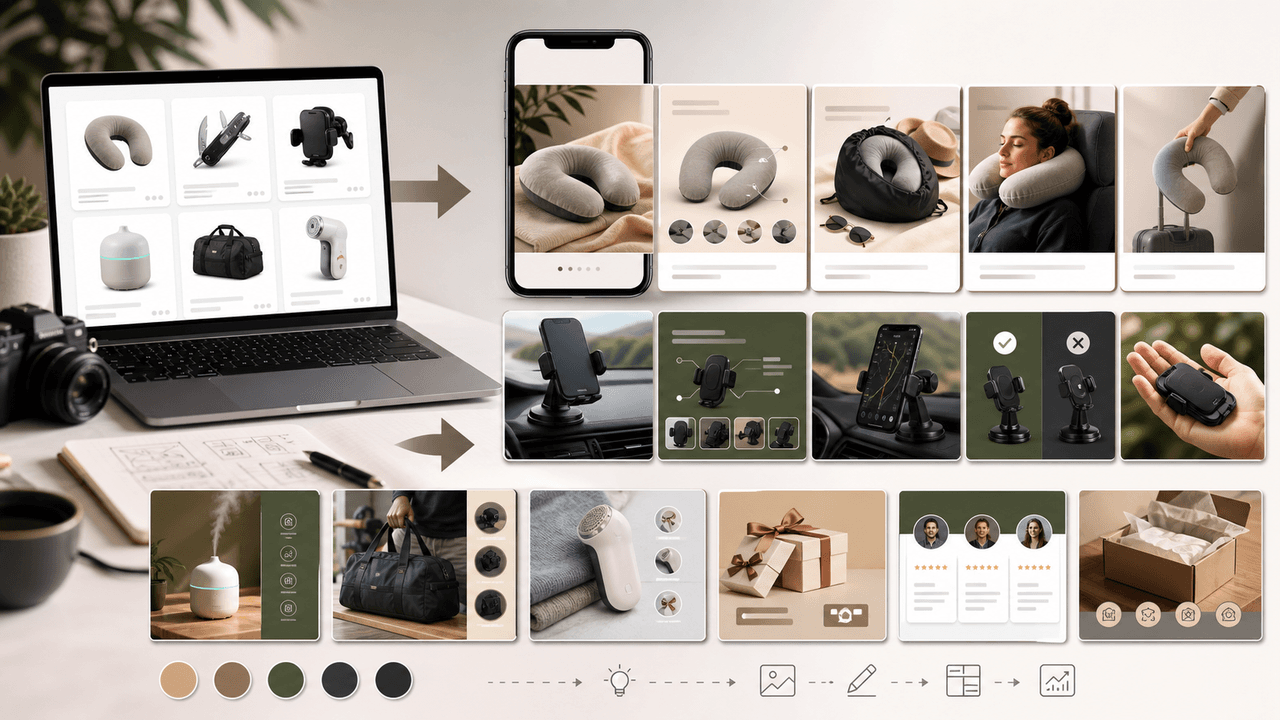
Instagram Carousels for Dropshipping: Content Strategy Without Product Photos
Dropshippers face a unique content challenge: they need to sell products they have never physically touched. This guide shows how to create effective Instagram carousels using supplier images, UGC, and design-forward formats that convert without custom photography.
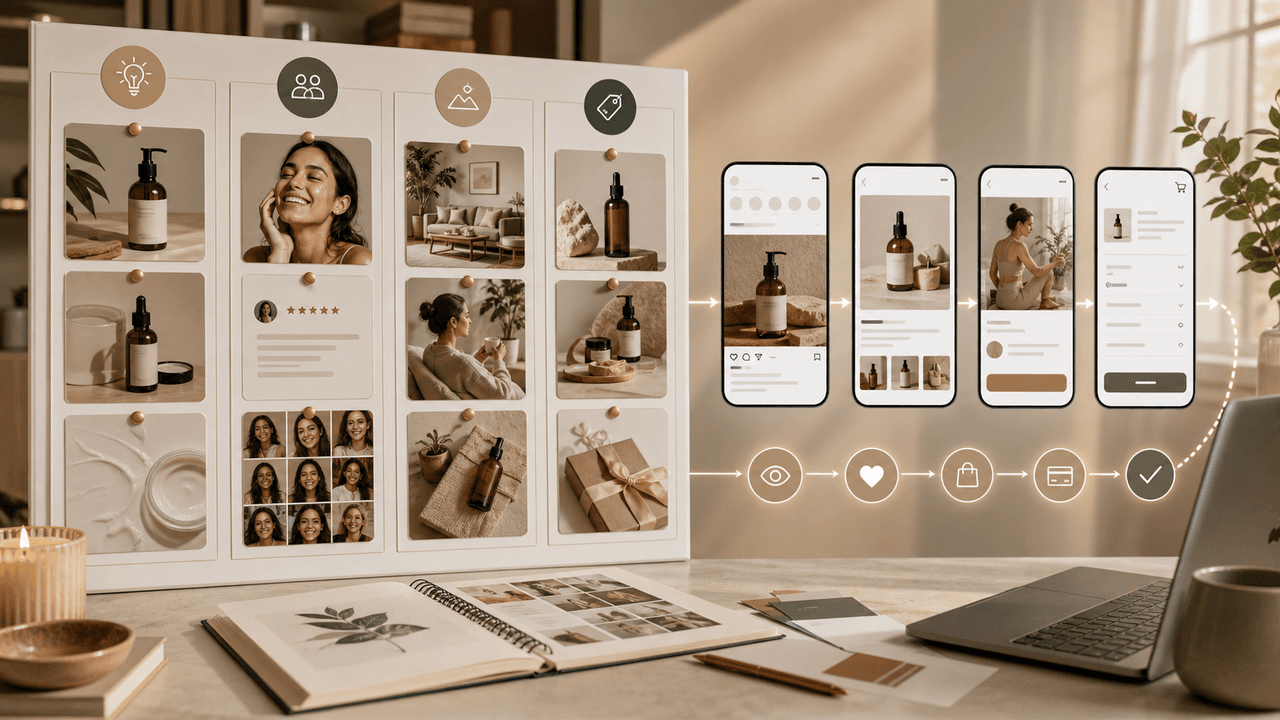
E-Commerce Instagram Content Pillars: The 5-Pillar Framework That Sells
Most e-commerce Instagram accounts either post too much product content and bore their audience, or too much lifestyle content and fail to sell. The five-pillar framework creates a balanced content mix that consistently educates, entertains, builds trust, and drives purchases.
A Beauty Brand Carousel Strategy Built Around Evidence
A responsible beauty carousel starts with the exact claim and its support, not a dramatic visual promise. Use current product facts, review express and implied messages, disclose material connections, and preserve the limits of the evidence on the slide where readers need them.
Sources
- Product bundles — Shopify Help Center
- Discounts — Shopify Help Center
- Design Specifications for Carousel Ads — Meta Business Help Center
- About Carousel Ads in TikTok Ads Manager — TikTok Ads Manager
Written by
AttentionClaw
Editorial Team
Editorial context
Part of the Content Planning topic cluster. Last updated June 22, 2026.