Chapter 1
What belongs in a beauty brand carousel strategy?
Build the strategy around four controlled inputs: the current product record, an approved claim library, authorized visual evidence, and a clear audience question. A carousel can then explain what the product is, how the brand directs people to use it, what an ingredient does in that formulation, or how one real customer describes an experience within the supported boundaries.
FDA says cosmetic labeling claims must be truthful and not misleading. Intended-use claims about treating or preventing disease, or affecting the body's structure or function, can make a product a drug under U.S. law. FTC guidance separately requires advertisers to identify express and implied messages and possess adequate substantiation before disseminating objective advertising claims.
Those are federal U.S. boundaries, not a complete global launch checklist. Product category, formulation, labeling, market, platform, and claim wording can change the analysis. Route uncertain health, safety, comparative, environmental, or regulated claims through qualified regulatory and legal reviewers before publication.
Callout
Design cannot rescue an unsupported claim
A disclaimer, footnote, attractive before-and-after image, or customer quote does not create evidence the brand does not already possess. Approve the complete message before designing it.
Chapter 2
Create a claim library that the content team can actually use
Replace loose marketing themes such as 'anti-aging' or 'skin transformation' with exact approved sentences. For each sentence, record the product and formulation it covers, the evidence owner, permitted channels and markets, required qualification, prohibited extensions, approval date, and expiration or re-review trigger.
Review the message a reasonable reader could take from the words, images, sequence, caption, creator delivery, and destination together. FTC health-products guidance emphasizes both express and implied claims. An image of a skin condition disappearing can imply treatment or efficacy even when the slide only says 'meet your new routine.'
Ingredient evidence is not automatically finished-product evidence. Do not convert a study about an ingredient, concentration, population, or test condition into a broader claim about a different formulation without an appropriately qualified review. Terms such as 'clinically proven,' 'dermatologist tested,' 'hypoallergenic,' 'non-toxic,' and 'FDA approved' require particular scrutiny and must not be used as vague credibility decoration.
Exact approved claim and the reasonable implied message reviewers considered.
Covered SKU, formulation version, market, audience, and channel.
Evidence reference, qualified evidence owner, and approval date.
Required qualification or disclosure and where it must appear.
Forbidden variants, including disease, structure/function, certainty, and comparison extensions.
Trigger for re-review: reformulation, new packaging, new study, new market, or changed guidance.
Chapter 3
Worked artifact: a beauty-claim approval matrix
This fictional example demonstrates the fields and decisions; it is not evidence for any real product.
Assume a fictional product called Example Cloud Cream. The current product record describes it as a cosmetic moisturizer, supplies a verified ingredient list and directions, and contains a brand-owned sensory study for the finished formulation. A qualified reviewer must still decide which messages that evidence supports.
- 1
Candidate: 'Cures eczema overnight' — reject
This communicates disease treatment and a guaranteed time-bound result. It is outside the fictional cosmetic brief and unsupported by the stated evidence. Do not soften it into a slide; remove it from the claim library.
- 2
Candidate: 'Clinically proven to rebuild the skin barrier' — hold
The sensory study does not support this clinical or structure/function message. Escalate the exact formulation, endpoint, study design, and intended market to qualified reviewers; do not publish while the status is unresolved.
- 3
Candidate: 'Leaves skin feeling softer after use' — conditional
A reviewer may consider this cosmetic sensory claim only against evidence for the finished formulation and complete context. Record the exact supported wording and any required use condition; do not upgrade 'feeling softer' into healing or lasting structural change.
- 4
Candidate: 'Fragrance-free' — verify product definition
Confirm the current formula, labeling, market-specific interpretation, and approved wording. An absent marketing fragrance is not a reason to guess about every ingredient or promise that irritation cannot occur.
- 5
Candidate: 'How to apply' — approve from current directions
Use the exact current brand directions and material warnings. Do not invent application frequency, compatibility, or safety advice beyond the reviewed product record.
Callout
The matrix is the production boundary
Only claims marked approved for the exact SKU, market, and channel may enter the draft. 'Hold' and 'reject' language belongs in production guardrails, not in alternate hooks.
Chapter 4
Worked artifact: a seven-slide moisturizer carousel
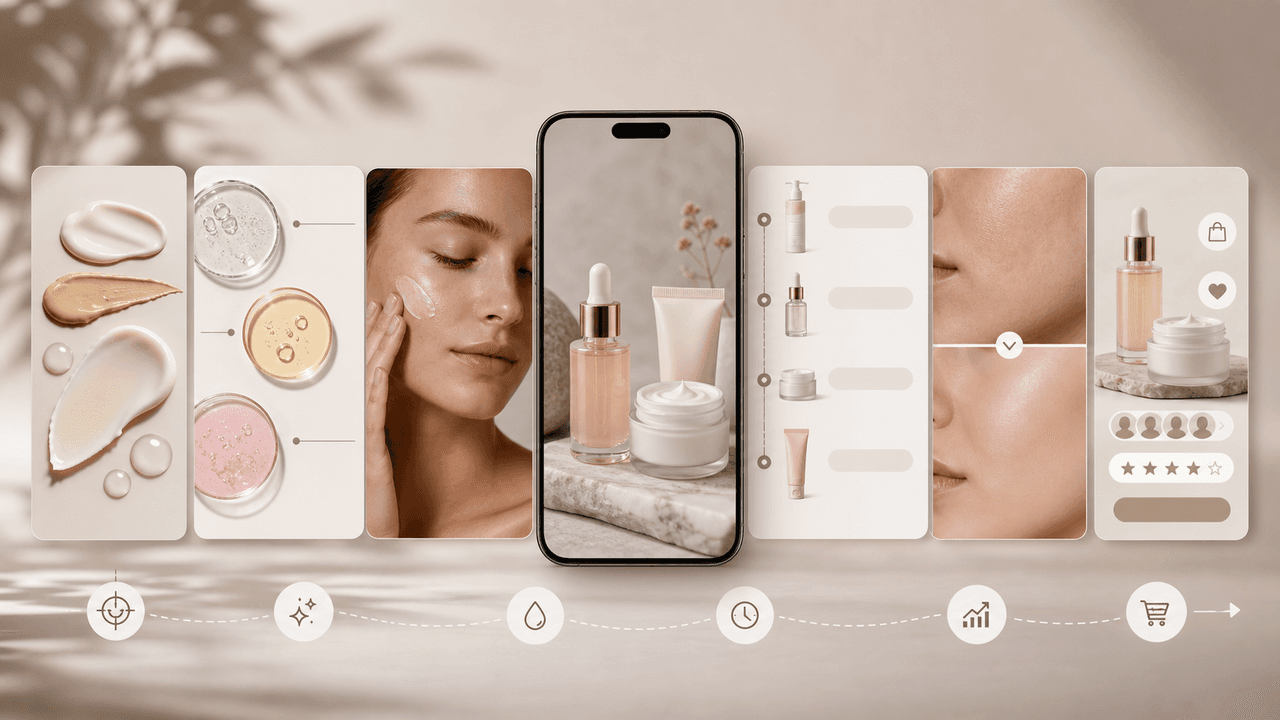
Continue with Example Cloud Cream and assume the claim library approves only the product identity, current directions, verified ingredient names, a narrowly worded sensory claim, and an unretouched product texture image. The carousel teaches selection and use without presenting medical advice.
- 1
Slide 1 — State the audience decision
Use 'What to check before adding a moisturizer to your routine' rather than a guaranteed transformation hook. The educational promise can be fulfilled without purchasing the product.
- 2
Slide 2 — Identify the product accurately
Show current packaging and the approved product identity. Do not display an obsolete formula, enlarge a certification mark beyond its authorized use, or imply FDA approval of the cosmetic.
- 3
Slide 3 — Explain the texture honestly
Use an unretouched texture image and the exact approved sensory wording. Label lighting or illustrative imagery when it could otherwise be read as a result demonstration.
- 4
Slide 4 — Show selected ingredients in context
Spell ingredient names as listed in the current source and describe their role only with approved wording. Link to the complete current ingredient list rather than presenting a selective list as exhaustive.
- 5
Slide 5 — Give the reviewed directions
Use the current product directions and warnings. Avoid diagnosing a skin concern or advising a reader to replace treatment recommended by a healthcare professional.
- 6
Slide 6 — State the boundary
Explain that individual sensory experience can differ and direct readers with medical concerns, allergies, or reactions to an appropriate professional and the brand's support or adverse-event contact path.
- 7
Slide 7 — Link to the complete product record
Invite readers to review current ingredients, directions, warnings, size, price, and availability on the product page. The destination must continue the same claim rather than escalating it after the click.
Chapter 5
Handle testimonials, reviews, and before-and-after images as advertising evidence
FTC endorsement guidance says endorsements must reflect honest opinions or experiences and cannot communicate claims the advertiser could not substantiate directly. A genuine customer quote is not proof that the same result is typical or that the product caused it. Review the quote, accompanying image, headline, edit, and brand reply as one message.
Obtain permission, preserve the speaker's meaning, verify the person used the covered product, and document any material connection. Do not remove qualifications, combine several people into one apparent customer, reorder a story to imply causation, or condition an incentive on a positive sentiment.
Before-and-after presentations need consistent capture conditions and an explicit edit record. Differences in lighting, pose, makeup, camera, timing, treatment, or image processing can create an implied product result. If the complete presentation communicates an objective outcome, the brand needs appropriate support for that outcome; a small 'results may vary' line does not cure a deceptive main message.
Keep the original permissioned testimonial and a record of edits.
Disclose gifts, payment, employment, ownership, family relationships, and other material connections clearly and conspicuously.
Check whether the featured experience is typical or whether the ad clearly communicates the generally expected result, as applicable.
Record capture conditions and prohibit skin reshaping, spot removal, or other result-altering edits.
Retire the creative if the quote, formula, evidence, disclosure, or relationship becomes inaccurate.
Chapter 6
Give creators claim boundaries, not a disguised script
A creator brief should separate facts the creator may state, personal experience they may describe honestly, unresolved claims they must not improvise, and the material-connection disclosure required for the relationship. FTC guidance recommends clear, straightforward disclosure and notes that disclosures should be hard to miss; the correct placement depends on the medium and complete presentation.
Do not tell a creator to say a product cured a condition, worked in a fixed time, is safe for everyone, or delivered a typical result unless the exact claim is lawfully supportable and approved. Monitor published work, correct departures, and retain the approved and live versions. Platform branded-content tools can supplement a disclosure workflow, but the team must still assess whether the disclosure is clear in the actual post.
Callout
A useful creator brief has four boxes
Approved product facts; permitted first-person experience; prohibited claim extensions; and the exact relationship disclosure plus placement instructions.
Chapter 7
Choose beauty content pillars that remain useful without a hard sell
A sustainable strategy does not need a fixed posting quota or a feed full of outcome claims. Build from audience decisions the team can answer accurately: reading a label, understanding product order from the brand's current directions, comparing verified texture or format attributes, checking a launch record, or seeing how packaging and shade references look under documented conditions.
Routine education should stay within the team's expertise. Separate cosmetic use instructions from medical diagnosis or treatment, and avoid universal compatibility claims. For questions about persistent symptoms, reactions, pregnancy, medication interactions, or diagnosed conditions, direct readers to an appropriate healthcare professional rather than improvising individualized advice in comments.
Product record: current identity, size, ingredients, directions, warnings, price, and availability.
Decision education: what a shopper can verify on the label or product page.
Formulation story: approved facts about texture, format, packaging, and production choices.
Customer voice: permissioned, representative context with claim and disclosure review.
Launch and update: what changed, what did not, and which product record is now current.
Chapter 8
Publish with an approval trail and measure the next action
Attach a claim ID to each slide before design. The reviewer should be able to move from a sentence or image back to its evidence, approved scope, required qualification, and owner. Preview the asset on the target platform so disclosures, warnings, ingredient names, and contrast survive cropping and compression.
Choose one measurable next action: current product-detail views, ingredient-list opens, shade-guide completions, or qualified support questions. Platform engagement and store behavior answer different questions; preserve each system's definitions and denominators rather than declaring that a save or view caused a purchase.
Use results to improve clarity, not to reverse-engineer a guaranteed posting time, frequency, or algorithm trick. A high-attention creative still needs correction if readers misunderstand the claim, disclosure, product, or destination.
Preview slides, caption, disclosure, alt text, and linked page together.
Verify the live SKU, formula, packaging, directions, warnings, price, and inventory message.
Keep a final claim map and screenshot of the published presentation.
Route reaction reports and product complaints to the brand's documented support and safety process.
Set a re-review trigger for formulation, evidence, creator relationship, guidance, or platform-format changes.
Chapter 9
Where AttentionClaw fits
AttentionClaw can turn an approved beauty brief, current product visuals, and a controlled claim library into branded carousel or slideshow drafts. A reusable visual system can help teams keep ingredient context, qualifications, and disclosures in predictable places.
AttentionClaw does not determine whether a product is a cosmetic or drug, assess scientific substantiation, verify a testimonial, approve a creator disclosure, or provide regulatory, medical, or legal review. Brand owners and qualified reviewers remain responsible for the source record, complete implied message, live publication, monitoring, and corrections.
Callout
Generate only from approved inputs
Lock the SKU, formulation, claim IDs, required qualifications, forbidden extensions, media rights, and destination before asking AttentionClaw for creative options.
Next step
Turn an approved beauty brief into a reviewable draft
Use AttentionClaw after claim, evidence, disclosure, media, and product records are approved, then keep qualified reviewers responsible for the final message.
Common Questions
FAQ
More Reading
Keep reading
8-chapter read
Jeweler Ring Sizing Instagram Carousels
Jeweler ring sizing carousels should help shoppers understand fit, width, resizing limits, surprise proposal questions, and appointment CTAs without overstating what can be resized.
8-chapter read
Boutique Product Drop Instagram Carousels
Boutique product drop carousels should show new arrivals, fit and material details, care information, inventory timing, review proof, and shopping CTAs without misleading scarcity or labeling claims.
7-chapter read
Jewelry Product Detail Instagram Carousels: Show Materials, Scale, and Story
Jewelry carousels sell best when they help a buyer judge detail: material, scale, craftsmanship, styling, occasion, and care. The content should be beautiful, but also precise about jewelry claims and buying context.
8-chapter read
Carousel Slide Order That Converts: Hook, Proof, Offer, CTA
A converting carousel usually follows a clear order: hook, context, problem, solution or product, proof, objection handling, offer, and CTA. The exact slide count can change, but the reader should never wonder why the next slide exists.
7-chapter read
How to Turn a Product Detail Page Into Social Content
A product detail page can become a full social campaign when you extract buyer questions, benefits, proof, variants, objections, reviews, and offers. The goal is not to copy the page into posts; it is to turn each product-page section into one useful social asset.
8-chapter read
Salon Before-and-After Social Content Guide: Book More Consultations
Salon before-and-after posts work when they show the consultation, starting point, process, maintenance, and realistic result. Use consent, consistent lighting, careful claims, and follow-up education to turn transformations into consultation bookings.
Four Product Carousel Formats Built Around Evidence
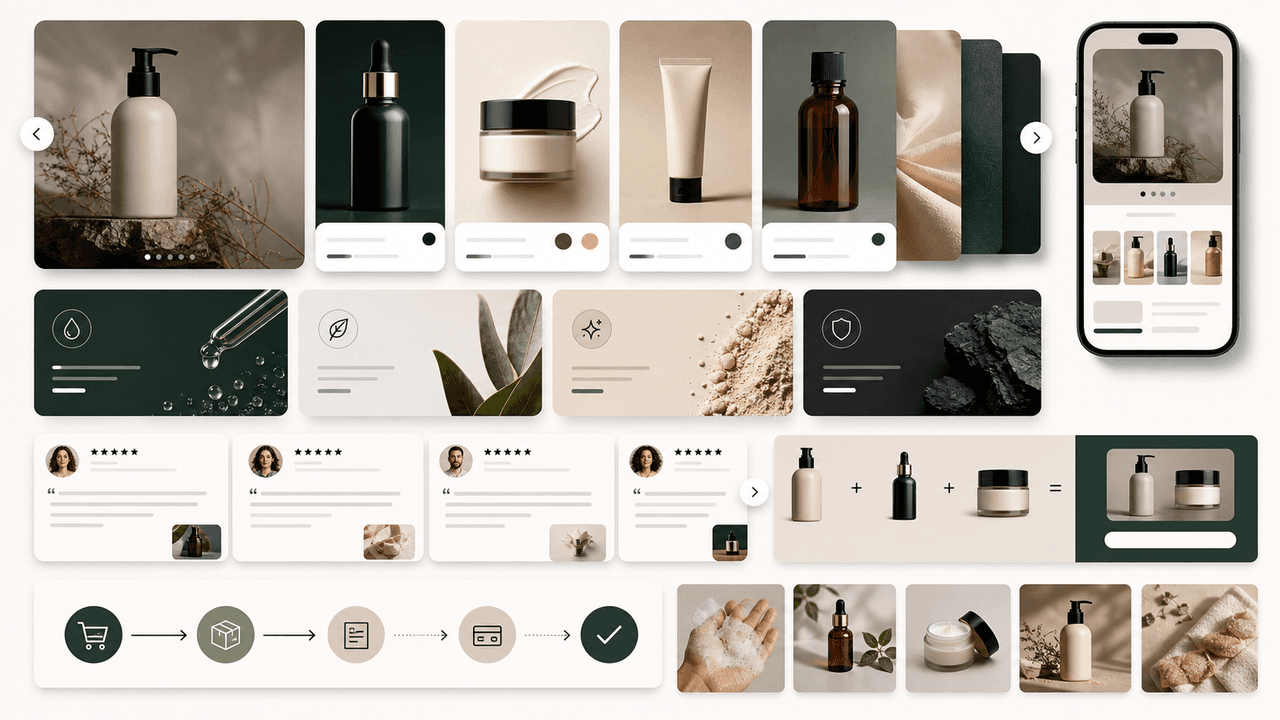
The best ecommerce carousel template depends on the buyer question and the evidence available. These four formats organize approved product details, media, comparison facts, bundle contents, and use cases into reviewable slide sequences without promising that a template will generate sales.

UGC Carousels for E-Commerce: Turn Customer Photos Into Your Best Sales Tool
User-generated content converts at 4-5 times the rate of brand-produced content, but most e-commerce brands either ignore UGC or use it poorly. Repurposing customer photos into structured carousel formats turns scattered social proof into your highest-performing sales asset.

E-Commerce Instagram Content Pillars: The 5-Pillar Framework That Sells
Most e-commerce Instagram accounts either post too much product content and bore their audience, or too much lifestyle content and fail to sell. The five-pillar framework creates a balanced content mix that consistently educates, entertains, builds trust, and drives purchases.
8-chapter read
Build a TikTok Product Launch Slideshow from the Offer Out
An ecommerce launch slideshow should answer one buying question with verified product evidence, preserve the exact offer across the post and destination, and adapt separately for organic photo posts, Shop links, or paid Carousel Ads.
Sources
- Cosmetics Labeling Claims — U.S. Food and Drug Administration
- Health Products Compliance Guidance — Federal Trade Commission
- FTC's Endorsement Guides: What People Are Asking — Federal Trade Commission
Written by
AttentionClaw
Editorial Team
Editorial context
Part of the Content Planning topic cluster. Last updated August 13, 2026.