
Chapter 1
What belongs in an Instagram product launch carousel?
A product launch carousel should state what is launching, identify the intended customer or use case, demonstrate the most relevant behavior, connect features to bounded benefits, present current offer details and material conditions, answer the decisive objection, and send the reader to one accurate destination.
The carousel cannot guarantee reach, sales, downloads, or sell-through. Treat it as one launch asset whose post-level performance can be inspected in Instagram Insights and whose downstream actions must be measured in the appropriate web, commerce, or product system.
Callout
Scope of this page
This page owns Instagram product-launch carousel execution. It does not own broad “content launch” planning, editorial launches, or an entire multichannel go-to-market strategy.
Chapter 2
Write the approved launch brief
Every field should point to a current source of truth and a named approver.
If a field remains pending, use an explicit placeholder in the internal brief and block publication. Never let a generation tool fill in an unknown price, date, testimonial, stock state, feature, or destination.
Product and version: exact public name, release state, and launch date or availability window.
Audience: one customer segment and the situation in which the product is relevant.
Problem: a specific observed need, not an exaggerated fear or invented market statistic.
Demonstration: the behavior, screen, product image, or use case the carousel can show directly.
Claims: approved feature, benefit, comparison, customer, and performance wording with sources.
Offer: current price, plan, quantity, geography, expiry, eligibility, and other material conditions.
Destination: exact product, store, signup, or purchase page and the desired action there.
Approvers: product, legal or policy, commercial, brand, and publishing owners as applicable.
Chapter 3
Complete the launch asset checklist
Meta treats branded content involving an exchange of value as requiring its paid partnership label, including certain gifted or affiliate content. The FTC also advises clear disclosure of material connections. Check the relationship, jurisdiction, and current platform requirements rather than copying a generic disclosure from another campaign.
- 1
Product evidence
Current screenshots, product photography, demo recording, feature documentation, and limitations that affect the use case.
- 2
Offer evidence
Approved price or plan, availability, inventory or capacity state, deadline, eligibility, and terms destination.
- 3
Proof permissions
Recorded permission for customer quotes, names, results, creator content, photographs, and logos. Keep qualifications beside the proof.
- 4
Brand system
Approved colors, typography, logo treatment, image crops, accessibility checks, and launch-specific visual elements.
- 5
Publishing packet
Caption, alt text, destination link, campaign identifiers, disclosure language, account tags, publish state, and correction contact.
Chapter 4
Worked artifact: announcement to evidence to action
Fictional launch: FocusMap, a planning app, adds an editable project starter. The example demonstrates structure and must not be reused as a real product claim.
Notice what the sequence omits: invented customer numbers, guaranteed time savings, false scarcity, unsupported “best” language, and multiple competing actions.
- 1
Slide 1 — announcement
“Launching today: an editable project starter for FocusMap.” This names the product change without promising an outcome.
- 2
Slide 2 — intended customer
“For small teams that know the project goal but do not want to start from a blank workspace.” The audience and situation are explicit.
- 3
Slide 3 — current problem
“A blank workspace still requires the team to define stages, owners, and the first task.” This is a product observation the team must verify, not a universal market claim.
- 4
Slide 4 — demonstration
“Choose a starter, preview its stages, and add it to an existing workspace.” Pair the sentence with current UI screens in the correct order.
- 5
Slide 5 — control and limitation
“Every stage and task remains editable; the starter does not assign teammates or publish a plan automatically.” The limitation keeps the demonstration accurate.
- 6
Slide 6 — offer details
“Available on the Team plan from 20 August in supported markets. Current plan details and conditions are on the pricing page.” Replace with approved real availability.
- 7
Slide 7 — decisive question
“Already have a workspace? The starter can be added without replacing existing projects.” Use only if verified for the release.
- 8
Slide 8 — one action
“See the editable project starter.” Link to the exact product page with the agreed campaign identifier.
Chapter 5
Create supporting carousels only when they have a different job
A launch may benefit from additional posts, but there is no universal number or schedule. Use real audience questions and available evidence to decide whether another asset is needed. Do not publish a near-duplicate carousel merely to fill a launch calendar.
Link broader brand and startup planning to the appropriate owners instead of stretching this page into a full campaign system: use the startup social media carousel guide for ongoing startup education and the ecommerce carousel templates when the task is ecommerce-specific.
Demonstration carousel: one use case shown from start to result state.
Comparison carousel: neutral criteria, current alternatives, and disclosed tradeoffs.
FAQ carousel: verified questions that block evaluation or purchase.
Proof carousel: approved evidence with context, permission, and material-connection disclosure.
Change-log carousel: what changed, who is affected, migration needs, and effective date.
Chapter 6
Review claims, proof, urgency, and accessibility
Match each claim to evidence and an owner. A product screen can verify current behavior; it does not prove a revenue or productivity result. A customer quotation can report that person's experience; it does not establish a typical result. A deadline is valid only when the offer actually changes at that time.
Review the rendered carousel for readable text and meaningful alternatives. Instagram lets publishers edit alternative text for photo posts, while WCAG 2.2 provides reference criteria for contrast and avoiding color-only communication. Describe essential product evidence rather than writing “colorful launch graphic.”
Product owner verifies names, screens, features, availability, and limitations.
Commercial owner verifies price, inventory or capacity, dates, eligibility, and terms.
Proof owner records testimonial, image, logo, and creator permissions.
Policy or legal reviewer checks regulated claims, comparisons, urgency, and disclosure as applicable.
Editor checks meaning, qualifications, alt text, destination, and the phone-sized export.
Chapter 7
Measure the launch carousel without inventing attribution
Record the Instagram metrics available to the professional account and the date-range definitions shown in Insights. For eligible web destinations, Google Analytics documents campaign parameters that can distinguish source, medium, campaign, and creative. Product and purchase outcomes remain in their respective systems.
Choose one primary downstream event before publishing and keep post signals as context. A high number of interactions with few qualified destination events may mean the post is useful but mismatched to the action; it does not justify claiming the carousel “converted” based on engagement alone.
Creative version and post URL.
Available Instagram views or reach and interactions.
Tagged destination sessions when supported.
Defined product, signup, or purchase event in the system of record.
Refunds, support questions, complaints, and corrections as qualitative context.
Unattributed activity retained as unattributed.
Chapter 8
Produce the launch carousel from approved inputs
Once the launch brief, claims, assets, and destination are approved, AttentionClaw can draft carousel copy and images, apply the product's brand style, and give the team a sequence to review and edit before publishing to Instagram or TikTok. The team remains responsible for approvals, live offer accuracy, publishing, and measurement.
Run a final same-day check when launch details can change. If price, availability, feature state, evidence, or destination no longer matches, block the post, correct the source brief, and regenerate only the affected assets.
Lock approved inputs and assign a creative version.
Draft the full sequence and caption together.
Compare every slide with its evidence and approver.
Test the destination and campaign parameters.
Publish, inspect the live post, and keep the correction owner available.
Next step
Create launch assets from an approved product brief
AttentionClaw drafts copy and images in your brand style so your team can review the complete launch sequence before publishing.
Common Questions
FAQ
More Reading
Keep reading
8-chapter read
Carousel Slide Order That Converts: Hook, Proof, Offer, CTA
A converting carousel usually follows a clear order: hook, context, problem, solution or product, proof, objection handling, offer, and CTA. The exact slide count can change, but the reader should never wonder why the next slide exists.
7-chapter read
How to Turn a Product Hunt Launch Into Social Posts
A Product Hunt launch can become a full social content system if you plan before launch day. Create pre-launch problem posts, launch-day announcement and demo assets, hourly reminders with real updates, objection-answer posts from comments, and post-launch onboarding content for people who discovered the product during the launch.

Build Instagram carousels around a measurable next step
A carousel cannot guarantee conversion. It can make one next step clear, give the reader enough evidence to evaluate it, and produce a testable signal. This guide shows how to design and measure that system.
10-chapter read
Product Launch Social Checklist for Shopify Brands
A Shopify product launch social checklist should connect store readiness with social creative: product page accuracy, product media, launch offer, audience segments, teaser posts, proof posts, carousel scripts, TikTok slideshows, claim review, destination links, UTM tracking, and post-launch learning.
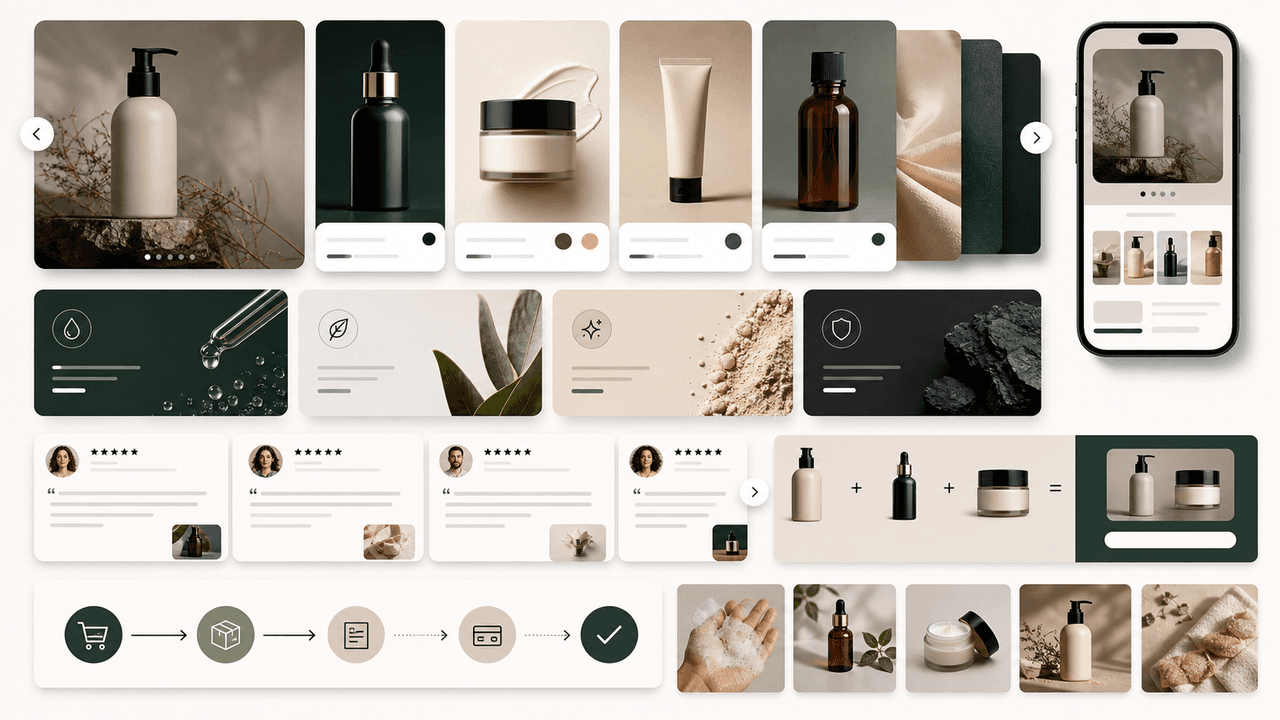
Four Product Carousel Formats Built Around Evidence
The best ecommerce carousel template depends on the buyer question and the evidence available. These four formats organize approved product details, media, comparison facts, bundle contents, and use cases into reviewable slide sequences without promising that a template will generate sales.

Run a small carousel experiment your startup can actually learn from
A lean startup carousel strategy built around audience decisions, available proof, a six-post experiment board, and measurements that stay inside their source systems.
Sources
- Share a Post — Instagram Help Center
- About Instagram Insights — Instagram Help Center
- Edit the alternative text for a post on Instagram — Instagram Help Center
- What is considered branded content — Instagram Help Center
- FTC's Endorsement Guides: What People Are Asking — Federal Trade Commission
- URL builders: Collect campaign data with custom URLs — Google Analytics Help
- Web Content Accessibility Guidelines (WCAG) 2.2 — World Wide Web Consortium
Written by
AttentionClaw
Editorial Team
Editorial context
Part of the Carousel Creation topic cluster. Last updated August 13, 2026.