Chapter 1
A podcast interview is a source library, not one clip
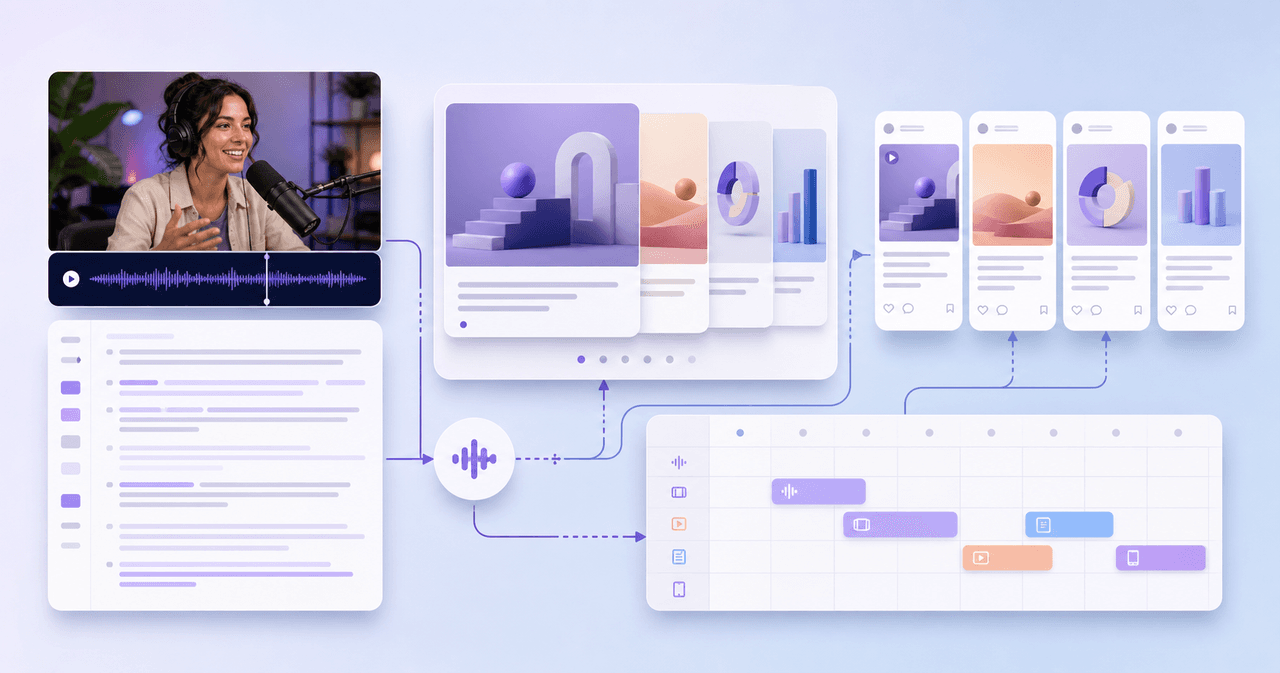
Podcast teams often reduce repurposing to short clips. Clips are useful when the guest says something emotionally strong, but they are only one layer. A good interview also contains arguments, examples, contradictions, recommendations, and audience questions that can become durable written and visual content.
Spotify for Creators frames growth around helping shows find and engage audiences. Repurposing supports that job when it gives each audience segment a different entry point into the episode. The listener who wants a full conversation can play the episode. The reader who wants a framework can save a carousel. The professional who wants a deeper argument can open a document or newsletter.
The best test is simple: if the asset would still be useful without the audio file, it is real repurposing. If it only says 'new episode out,' it is promotion.
Clips capture emotion and voice.
Pull quotes capture memorable claims.
Carousels capture frameworks and steps.
Documents capture nuanced arguments.
Newsletters capture editorial interpretation.
CTA posts capture the next action.
Chapter 2
Run the six-marker transcript pass
Use the transcript to mark content by future asset type, not by timestamp alone.
- 1
Guest thesis
Find the sentence that best summarizes the guest's point of view. This becomes the anchor for the episode summary, carousel hook, and newsletter subject.
- 2
Story with stakes
Mark the story where something changed: a mistake, a turning point, a client result, a failed launch, or a difficult decision. This becomes a short script or narrative post.
- 3
Named method
Extract any framework, process, checklist, or decision rule. This becomes the most saveable carousel because the reader can apply it without listening to the full episode.
- 4
Contrarian line
Pull the strongest disagreement with common advice. This becomes a text post, quote slide, or discussion prompt.
- 5
Resource mention
Capture tools, books, templates, or articles the guest recommends. These become show-note upgrades or newsletter links.
- 6
Audience question
If the interview was live or collected listener prompts, identify the question that most clearly maps to future content. Questions are demand signals.
Chapter 3
Build assets the guest will actually share
Guest distribution is one of the biggest advantages of interview repurposing. But guests rarely share generic episode graphics. They share assets that make them look clear, useful, and credible.
Apple Podcasts provides marketing tools for creators to generate show and episode assets. Those assets are helpful for baseline promotion, but a high-performing guest-share package should go further: one quote graphic, one carousel built around the guest's method, one short caption the guest can personalize, and one direct episode link.
Send the package before publication or within 24 hours after launch. Make the guest's job easy: include the asset files, suggested caption, tag handles, and the precise link. The more the package feels like a professional media kit, the more likely it is to be used.
Lead with the guest's sharpest idea, not the host brand.
Use the guest's preferred title and spelling.
Avoid over-editing quotes until the guest's voice disappears.
Give the guest a carousel and a short text option.
Include one clean link with campaign tracking.
Chapter 4
Turn the guest method into a carousel
The carousel should teach one method from the interview. Do not make it an episode recap. A recap usually becomes a list of topics. A method carousel becomes a useful asset someone saves, shares, and remembers.
Use this structure: hook with the outcome, introduce the guest insight, list the steps, show one example, name a mistake, and point to the full episode or newsletter for depth. This gives enough value to stand alone while making the full conversation more attractive.
Meta's carousel format guidance for ads describes a multi-card unit. Use that discipline for organic content: each slide gets one job. If the slide tries to hold two ideas, split it or cut one.
Callout
Carousel angle test
If the carousel title starts with 'Highlights from our interview,' rewrite it. Lead with the reader outcome, such as 'The 4-part system this founder uses to turn every interview into a content engine.'
Chapter 6
Use a LinkedIn document for B2B and expert interviews
Some interviews are too useful to compress into a short post. If the guest is a consultant, educator, founder, researcher, or operator, turn the interview into a document that explains the method with enough context to be credible.
LinkedIn describes Document Ads as documents people can view and download in feed. Organic teams can use the same content pattern without making an ad: publish a compact document that summarizes the expert method and links back to the full conversation.
The document should not include every question. It should include the argument, framework, example, lesson, and next step. Think of it as a field guide based on the interview.
Chapter 7
Track the episode campaign across formats
Interview assets have different jobs. The quote graphic may drive shares. The carousel may drive saves. The newsletter may drive listens. The guest package may drive new audience exposure. Measure them separately but review them as one episode campaign.
Google Analytics campaign URL guidance explains that custom campaign parameters identify traffic sources and campaigns. Use a campaign name tied to the episode, then use content labels for quote, carousel, guest_share, newsletter, document, and episode_cta.
After two weeks, compare formats by job. If the quote got shares but no listens, it may have built awareness. If the carousel got saves and newsletter clicks, it may be the best bridge to deeper consumption.
Chapter 8
Where AttentionClaw fits
AttentionClaw is most useful after you have marked the transcript. The tool should not guess the guest's thesis. You identify the thesis, method, story, quote, and CTA. Then AttentionClaw can turn those inputs into polished visual assets across carousel and slideshow formats.
For podcast hosts, agencies, and expert businesses, that means every interview can become a repeatable production package instead of a scramble for clips.
Callout
Turn interview transcripts into reusable assets
Use AttentionClaw to transform interview transcripts into branded quote assets, carousels, and social post drafts without losing the guest's strongest ideas.
Next step
Turn every podcast interview into a reusable content package
AttentionClaw helps you convert transcript highlights into quote assets, carousels, and social drafts that guests and audiences can actually use.
Common Questions
FAQ
More Reading
Keep reading
7-chapter read
Give the host an approval-ready promotion packet
A podcast guest appearance needs a coordinated handoff, not just a link post. Agree on asset rights and timing, package approved quotes and visuals, make host approval easy, and keep a correction path open after launch.
10-chapter read
How to Repurpose an Expert Roundtable Into High-Trust Social Content
An expert roundtable becomes strong social content when you separate consensus, disagreement, frameworks, proof, unanswered questions, and next-step CTAs.
10-chapter read
How to Turn Office Hours Replays Into a Content System
Office hours replays become a content system when questions, blockers, examples, corrections, and action steps are captured, anonymized, and mapped to public or member-only assets.
11-chapter read
How to Turn an AMA Session Into FAQ Content
An AMA session becomes durable FAQ content when you cluster repeated questions, write direct answers, add caveats and sources, and repurpose each cluster into social assets.
10-chapter read
How to Turn Podcast Show Notes Into Social Posts
Podcast show notes are a structured source for social content when you separate the episode promise, guest authority, timestamps, resources, questions, and CTA.
10-chapter read
How to Turn Any Transcript Into Short-Form Content
A transcript becomes useful short-form content when you extract claims, stories, frameworks, questions, objections, and action steps instead of pasting spoken paragraphs into social formats.
10-chapter read
How to Turn One Blog Post Into a Full Social Content System
A strong blog post can become a full social content system when you extract the direct answer, framework, examples, sources, objections, and CTA separately instead of summarizing the whole article.
10-chapter read
How to Turn Expert Interviews Into LinkedIn Newsletters
An expert interview becomes a strong LinkedIn newsletter when you turn it into an editorial brief: thesis, context, expert framework, evidence, practical takeaway, and next-step CTA.
How to Turn One Newsletter Into a Week of Social Content
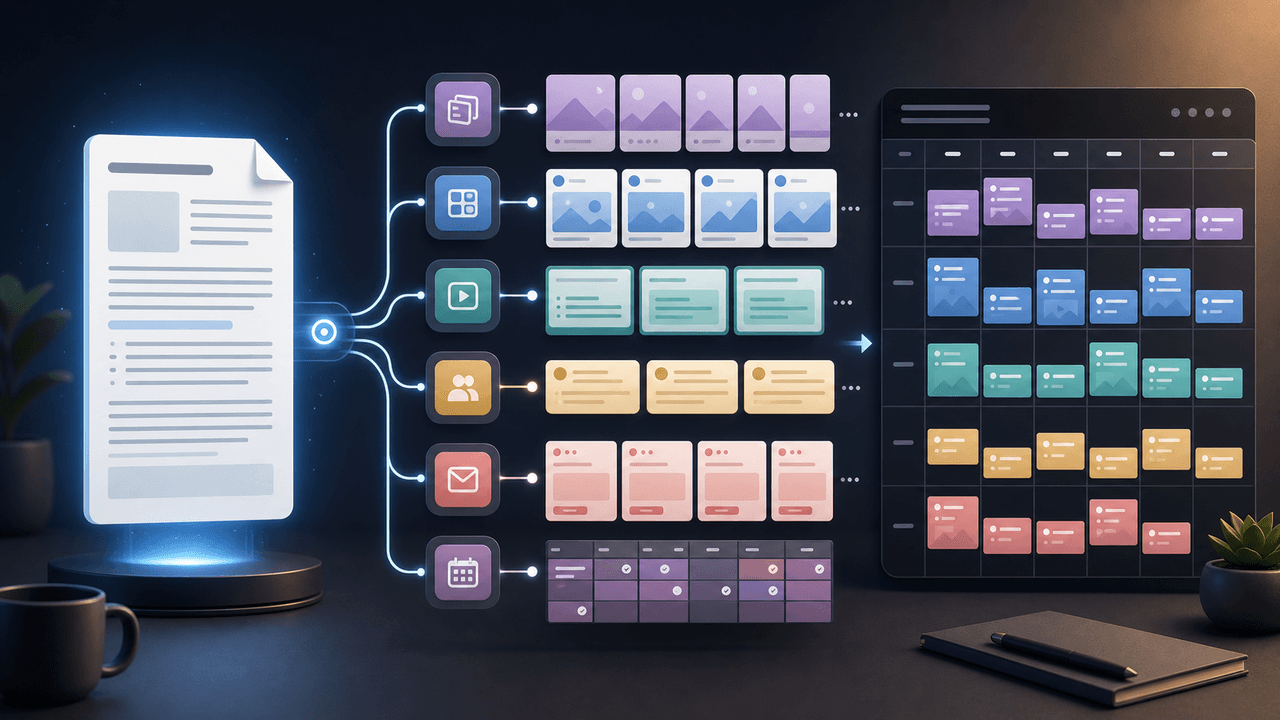
A strong newsletter is not one finished asset. It is the source file for a week of social posts, carousels, short scripts, community posts, and follow-up emails when you extract the argument, proof, examples, and reader questions separately.
Turn one podcast theme into a sourced carousel
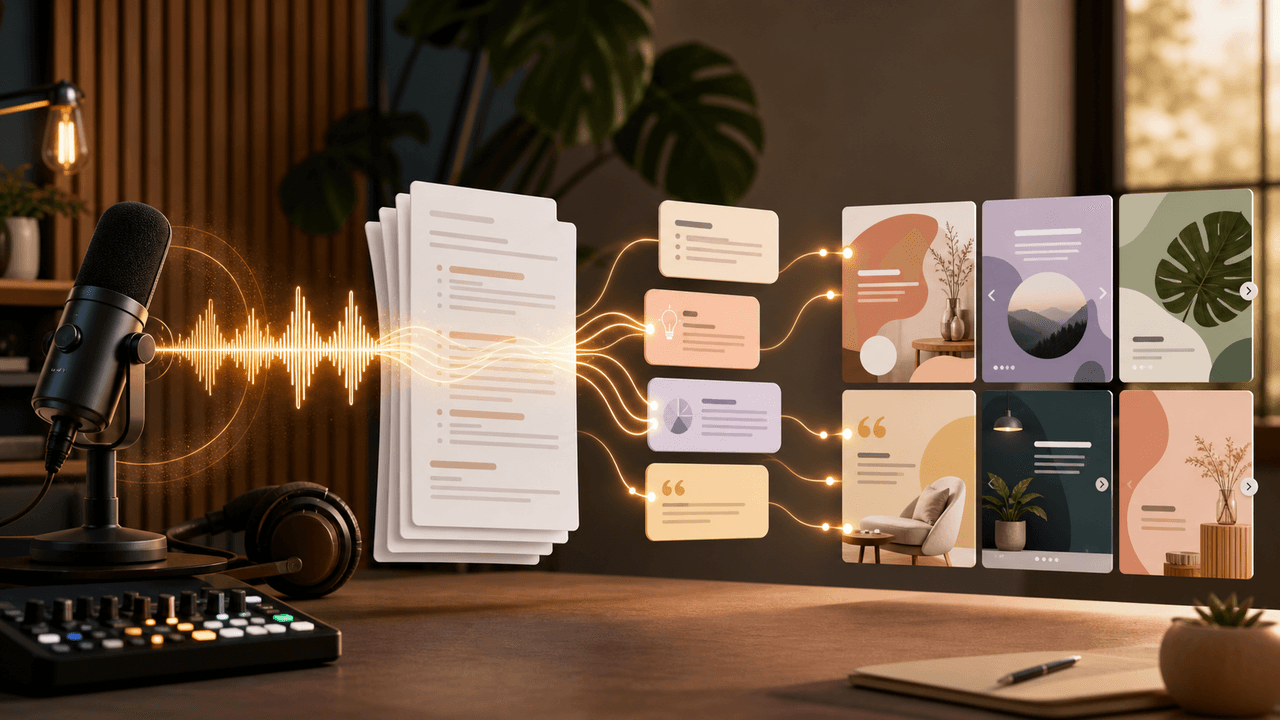
A podcast carousel should preserve the episode's meaning, not compress a transcript into disconnected quotes. This workflow selects one defensible theme, traces every slide to source material, and sends the finished sequence through approval.
Sources
- Grow Your Audience — Spotify for Creators
- Apple Podcasts Marketing Tools — Apple Podcasts for Creators
- Design Specifications for Carousel Ads — Meta Business Help Center
- Writing Email Newsletters — Mailchimp
- URL Builders: Collect Campaign Data With Custom URLs — Google Analytics Help
Written by
AttentionClaw
Editorial Team
Editorial context
Part of the Repurposing topic cluster. Last updated June 22, 2026.