Chapter 1
The direct answer: describe facts and research paths, not ideal residents
Real estate neighborhood guide social content should describe factual amenities, housing types, transit or commute options, public resources, market process, and questions buyers can research. It should avoid steering language, protected-class references, and unsupported claims about safety, schools, demographics, or who the area is 'perfect for.'
HUD fair housing resources and NAR fair housing guidance are relevant because public real estate marketing can influence housing choices. Social media posts, stories, videos, and paid ads should be reviewed like other advertising.
A useful neighborhood guide says 'here are local amenities and questions to research' rather than 'this is the best place for young families.'
Callout
Neighborhood content rule
Describe property and community facts. Do not describe the ideal buyer or imply who should live in the area.
Chapter 2
Five safer pillars for neighborhood guide posts
Agents can still be locally useful without risky language. The safest neighborhood content focuses on verifiable details and buyer research prompts.
Use five pillars: amenities, housing stock, logistics, market process, and buyer questions. Amenities cover parks, libraries, transit stops, restaurants, and public resources. Housing stock covers property types and common features. Logistics covers commute routes and parking facts where verified. Market process explains how to evaluate listings. Buyer questions encourage consumers to research what matters to them.
This turns the agent into a guide without making the agent the judge of what community is right for a protected group.
Amenities: parks, trails, libraries, grocery areas, business districts, transit stops.
Housing stock: condos, single-family homes, townhomes, lot sizes, age ranges, common layouts.
Logistics: commute routes, parking options, transit links, walkability resources, public data sources.
Market process: inventory, showing strategy, offer timeline, inspection considerations.
Buyer questions: commute, budget, accessibility, lifestyle needs, local services, personal research.
Chapter 3
Language to avoid in local guide content
Neighborhood posts often sound harmless until they imply preference. Phrases like 'perfect for families,' 'young professional area,' 'safe neighborhood,' or 'exclusive community' can create risk depending on context and local rules.
Replace subjective labels with factual details. Instead of 'family-friendly,' say 'near public parks, recreation fields, and a library.' Instead of 'safe,' direct buyers to public data sources and encourage independent research.
If the brokerage has required fair-housing language, equal housing logos, or advertising review procedures, use them consistently.
- 1
Remove ideal-buyer labels
Do not say who the area is for.
- 2
Use verifiable details
Name amenities, property features, and public resources rather than subjective judgments.
- 3
Encourage independent research
Tell buyers to evaluate schools, commute, safety, and services using public sources and personal needs.
Chapter 4
Neighborhood post formats that build trust
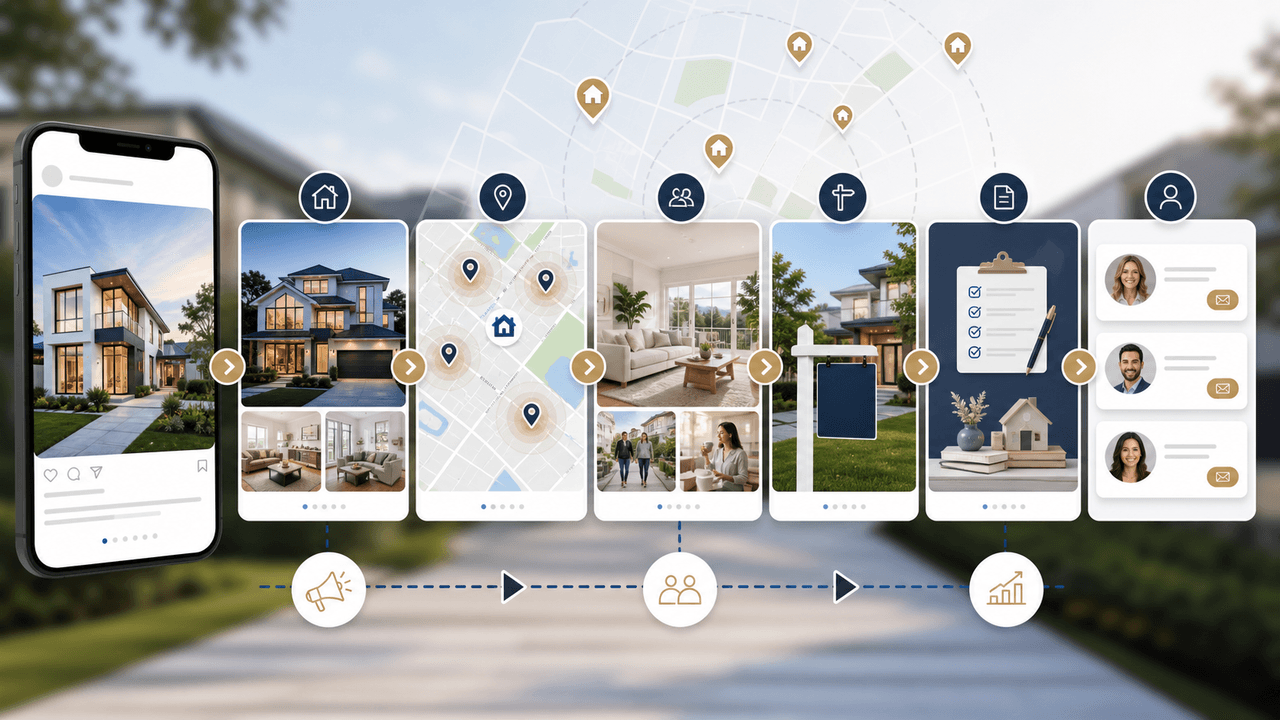
A local guide can be a carousel, map-style slideshow, short walking tour, listing-adjacent post, or buyer checklist. The format should make facts easy to scan.
Keep visuals grounded: actual street scenes where allowed, public amenities, transit stops, market snapshots, and listing-area maps. Avoid stock imagery that could apply to any city.
Use dates for market information. Inventory, prices, and days on market change, so evergreen neighborhood posts should avoid time-sensitive claims unless they are updated.
Five local amenities near current listings.
What to research before choosing a neighborhood.
Common housing styles in this area.
How to compare commute options.
Questions to ask before an open house.
Public resources buyers can check themselves.
Monthly market context with date and source.
Accessible route and transit notes where verified.
Chapter 5
How AttentionClaw helps agents build local guides
AttentionClaw helps agents turn verified local facts, listing context, and brokerage-approved language into neighborhood guide carousels and slideshows.
The agent supplies local facts, source notes, fair-housing review, and brokerage requirements. AttentionClaw packages that material into repeatable content without resorting to city-name swap pages.
This gives buyers useful local context while keeping the agent's marketing focused on facts, research prompts, and next steps.
Callout
Neighborhood guide workflow
Collect verified local facts, remove ideal-buyer language, review fair-housing requirements, generate the carousel in AttentionClaw, and update dated market claims.
Chapter 6
A worked example: a walkable neighborhood guide post
The following shows how a real estate agent can build a neighborhood guide post around verified, non-steering content. The topic is walkability — a factual amenity angle that helps buyers understand the area without implying anything about who should live there.
The post opens with a map-style graphic or a photo walk graphic: 'What's within a 10-minute walk of [neighborhood name]?' Subsequent slides list specific, verifiable facts: three coffee shops within five blocks, a farmer's market on Saturday mornings, a transit stop on the main corridor, and a library branch two streets over. Each slide names the specific place and the approximate distance — not subjective adjectives, just facts a buyer can verify on a map.
The final slide is the research path slide: 'Interested in seeing listings in [neighborhood name]? Here's how to start.' This CTA invites curiosity without making any claim about who the neighborhood is 'for.' The agent's value is in knowing the area well enough to provide the specific, verified details — that's a differentiator that a generic listing portal can't replicate.
- 1
Slide 1 — Hook
'What's actually within walking distance of [neighborhood name]? We mapped it.' Use a real photo of the area, not a stock skyline.
- 2
Slides 2–5 — Specific amenities
One amenity category per slide: food and coffee, transit, green space, services (library, post office, pharmacy). Name specific places, give approximate distances, and let buyers draw their own conclusions.
- 3
Slide 6 — Market context (optional)
If including any market data, use publicly available figures and cite the source. Keep it factual: 'median list price this quarter according to [public source].' Skip if current data isn't verified.
- 4
Slide 7 — Research path CTA
'Want to see what's available in [neighborhood name]? Start with a search link or message me.' No steering language — just an open invitation.
Chapter 7
A practical language review process before posting
The easiest way to catch risky language before posting is to run a simple replacement test: take every descriptive word or phrase in the post and ask whether it implies a preference about the type of person who should live in the area. 'Young professionals' implies age and career status. 'Family-friendly' implies household composition. 'Quiet and safe' can imply comparative statements about other areas. If a phrase passes through that test and still feels necessary, ask whether there's a factual version that communicates the same information: 'good school ratings' instead of 'great for families,' or 'low traffic on residential streets' instead of 'quiet neighborhood.'
For agents who produce neighborhood content at scale, building a pre-approved phrase library is worth the upfront time. Work with your brokerage compliance team to create a list of approved neighborhood descriptors — specific, factual, amenity-focused — and a list of phrases to avoid. Having this library available when producing carousel content reduces the back-and-forth review cycle and keeps posts consistent across the team.
When in doubt, the safest frame is the buyer's research process: 'Here are the facts; here's how you can verify them; here's how to start a search.' That frame positions the agent as a local resource, not a salesperson, and it sidesteps language risk by keeping the content descriptive rather than prescriptive.
Chapter 8
Turning one neighborhood into a multi-post content series
A single neighborhood guide post rarely exhausts the content potential of an area. Agents who specialize in specific neighborhoods can build a recurring series that goes deeper over time: one post on walkability, a follow-up on the commute options (transit routes, parking reality, drive times to common employer clusters), a third on the housing stock mix (when the homes were built, what renovation generations exist, condo versus single-family proportions), and a seasonal post covering what the neighborhood looks and feels like at different times of year.
Each post in the series should reference the others — 'part of our [neighborhood name] local guide series' — to signal to followers and the algorithm that this agent is the area specialist. Over a quarter, that series becomes a searchable, saveable resource that differentiates the agent far more than individual listing posts.
Post 1: Walkability and amenities map
Post 2: Commute and transit reality check
Post 3: Housing stock overview and renovation context
Post 4: Seasonal character — what the neighborhood looks like in different conditions
Post 5: Buyer FAQ — questions the agent gets most often about the area
Next step
Turn local facts into fair-housing-aware real estate guides
AttentionClaw helps agents package verified amenities, buyer research prompts, and brokerage-approved language into neighborhood guide carousels and slideshows.
Common Questions
FAQ
More Reading
Keep reading
8-chapter read
Real Estate Investor Education Instagram Carousels
Real estate investor education carousels should explain due diligence, risk questions, property math, scam warning signs, and consultation CTAs without promising passive income or guaranteed returns.
9-chapter read
Home Inspector Buyer Prep Instagram Carousels: Explain the Inspection Before the Appointment
Home inspector buyer-prep carousels should explain what an inspection is, what buyers should attend to, what the report can and cannot do, and how to book without overpromising findings.
9-chapter read
Property Management Vacancy Instagram Carousels: Market Rentals With Guardrails
Property management vacancy carousels should show the rental clearly, explain application steps, avoid discriminatory language, and route prospects to current listing details. Good social content reduces questions without creating fair housing or maintenance risk.
8-chapter read
Mortgage Broker Loan Estimate Carousel Content: Explain Without Misleading
Mortgage Loan Estimate carousels should teach buyers what to review, what to compare, and what questions to ask without advertising unavailable terms or giving personalized loan advice in public posts.
9-chapter read
Real Estate Open House Social Content: Promote Listings Without Losing the Plot
Open house social content should help qualified visitors understand the property, schedule, showing logistics, and next step while respecting fair housing, listing accuracy, and safety. A good campaign includes teaser posts, day-of reminders, property-feature carousels, visitor FAQs, and follow-up content.
9-chapter read
Real Estate Seller Lead Social Content: Posts That Earn Listing Consultations
Seller lead social content should help homeowners understand preparation, pricing conversations, timing, local market context, and listing consultation next steps. The best posts are accurate, fair-housing aware, locally useful, and designed to turn curiosity into valuation or consultation requests.
8-chapter read
Real Estate Listing Social Media Checklist: Carousels, Reels, and Local Trust
A real estate listing social media checklist should package the property, neighborhood, buyer questions, showing path, and compliance review into a clear launch sequence. The best listing content attracts qualified interest without using discriminatory language or unsupported claims.
8-chapter read
Social Content SEO and AI Search Visibility Playbook
Social content can support SEO and AI search visibility when teams turn repeat social questions into source-backed articles, structured answers, FAQs, internal links, and reusable lead magnets. The goal is not to make every post rank; it is to build a content system where social evidence feeds durable search pages.
Real Estate Carousel Marketing With Facts, Context, and Fair-Housing Guardrails
Real estate carousel marketing works best as a documented publishing process: verify authority and facts, describe the property rather than a preferred resident, disclose the professional source, and give every slide one useful job.

Local Business Instagram Carousels: Drive Foot Traffic Without Paid Ads
Local businesses do not need viral content. They need carousels that reach the right 5,000 people within a ten-mile radius. A local carousel strategy turns your expertise, your team, and your community presence into foot traffic without spending a dollar on ads.
Sources
- Advertising and Marketing — U.S. Department of Housing and Urban Development
- Fair Housing Rights and Obligations — U.S. Department of Housing and Urban Development
- Fair Housing — National Association of REALTORS
- Social Media Best Practices for Real Estate Professionals — National Association of REALTORS
- Understanding the Impact of the Fair Housing Act on Advertising — National Fair Housing Alliance
Written by
AttentionClaw
Editorial Team
Editorial context
Part of the Content Planning topic cluster. Last updated June 22, 2026.