Chapter 1
The direct answer: teach the listing decision before asking for the lead
Real estate seller lead social content should answer the questions homeowners ask before contacting an agent: What is my home worth? What should I fix first? When should I list? How do showings work? What photos matter? What does a listing consultation include? What makes one agent's launch plan different?
The goal is not to publish vague market hype. The goal is to create trust around the listing process. A homeowner who saves a prep checklist, watches a pricing explainer, and clicks a valuation post is moving toward a listing consultation.
Because real estate marketing is regulated and fair-housing sensitive, posts should be reviewed for accuracy and inclusivity. HUD and NAR fair housing resources are relevant even for seller content because listing promotion eventually reaches buyers and public audiences.
Callout
Seller content rule
Talk about property preparation, pricing process, timing, and marketing plan. Avoid language that implies who should buy or live in the home.
Chapter 2
Five seller lead content pillars
Seller leads usually need education before they are ready to raise their hand. They may be watching prices, considering repairs, comparing agents, or waiting for a life event. Content should meet each stage.
The five pillars are prep, pricing, process, proof, and consultation. Prep content helps homeowners improve presentation. Pricing content explains comparable sales and market context without promising a number publicly. Process content shows the listing timeline. Proof content shows marketing execution and seller experience. Consultation content explains how to start.
This mix works for agents, teams, and brokerages because it gives homeowners multiple reasons to follow before they are ready to list.
Prep: repairs, cleaning, staging, photography, curb appeal, documents.
Pricing: comparable sales, condition, timing, inventory, buyer feedback.
Process: listing timeline, photos, showings, offers, inspection, closing.
Proof: case studies, marketing plan examples, launch assets, seller testimonials where compliant.
Consultation: valuation request, listing walkthrough, strategy call, what to prepare.
Chapter 3
Seller lead posts that answer real homeowner questions
Seller content should be specific enough that a homeowner can use it. 'Now is a great time to sell' is not useful by itself. 'Five things I check before recommending a list price' gives the seller a reason to trust the agent's process.
Use local context without making unsupported market claims. If discussing inventory, days on market, or price trends, use current local data and cite or name the source where appropriate. If the post is evergreen, focus on process rather than time-sensitive statistics.
A strong seller content calendar mixes evergreen education with timely market commentary. Evergreen posts can run all year. Market posts need dates and updates.
What a listing consultation includes.
Repairs to consider before photos.
What not to renovate before calling an agent.
How agents use comparable sales.
Why online estimates can differ from a listing strategy.
What sellers should gather before a consultation.
How staging changes listing photos.
The timeline from consultation to live listing.
What happens after the first weekend on market.
Questions to ask before choosing a listing agent.
How to prepare for listing photos.
What seller concessions can and cannot solve.
Chapter 4
Review seller content through a fair-housing lens
Seller content often feels less risky than buyer-facing listing content, but it still shapes public marketing. Posts about neighborhood, schools, ideal buyers, or lifestyle can create fair-housing problems if they imply preferences or exclusions.
NAR provides fair housing guidance and support for compliance, and HUD's advertising and marketing resources are core references for housing advertising. Agents should keep seller education focused on property features, marketing process, preparation, and seller decisions.
Instead of saying a home is 'perfect for young families,' say it has four bedrooms, a fenced yard, and proximity to public amenities where accurate. Let consumers decide whether the property fits them.
- 1
Describe property, not people
Use bedrooms, layout, features, amenities, and showing details rather than ideal-buyer labels.
- 2
Use factual local context
Avoid unsupported claims about safety, demographics, or who belongs in an area.
- 3
Check brokerage requirements
Confirm brokerage name, license details, disclaimers, and platform rules where required.
Chapter 5
Use Google Business Profile to support seller trust
A homeowner may see a seller tip on Instagram and then search the agent's name. Google Business Profile updates and photos can reinforce that the agent is active, local, and professional.
Use Google posts for seller seminars, market update events, open consultation windows, office updates, and service reminders. Use profile photos to show the office, team, signage, community events, and professional listing work where allowed.
Keep the same CTA across channels. If the seller post offers a valuation consultation, the Google update, website, and social bio should all point to the same request path.
Seller seminar announcement.
Monthly local market update with date and source.
Listing-prep checklist post.
Recently sold process recap without sensitive details.
Consultation availability post.
Professional team or office photo update.
Chapter 6
How AttentionClaw helps agents build seller lead campaigns
AttentionClaw helps agents turn seller education into consistent campaigns: prep checklist, pricing explainer, listing timeline, consultation FAQ, market update, and seller proof post.
The agent supplies local data, brokerage-approved language, and fair-housing review. AttentionClaw helps package that information into carousels and TikTok slideshows that look consistent across the month.
Build a seller content library once, then update local examples and market notes monthly. This gives the agent durable content instead of starting from scratch every time the market changes.
Callout
Seller lead workflow
Choose seller question, add local context, review for fair housing and brokerage rules, generate assets in AttentionClaw, publish, and track consultation requests.
Chapter 7
Measure listing consultation intent
Seller lead content should be measured by valuation clicks, consultation requests, saved checklists, DMs about timing, seminar registrations, and homeowners who mention social content during listing appointments.
Different posts serve different time horizons. A pricing explainer may generate immediate DMs. A prep checklist may sit in a homeowner's saved folder for months. A market update may build local authority slowly.
Track the path from post to consultation. When a homeowner books, ask which content helped them understand the process. Use those answers to build the next seller series.
Track valuation form starts by post.
Track seller consultation requests.
Track saved prep and pricing posts.
Track DMs about timing, repairs, and market value.
Track listing appointments where the homeowner mentions a post.
Chapter 8
Creating timing-focused content that reaches homeowners before they decide
Most homeowners begin thinking about selling months before they contact an agent. The sellers who call an agent first are rarely the ones who saw one post — they are the ones who saw repeated, consistent, useful content from the same agent over a period of weeks or months. Timing-focused content is specifically designed for this pre-decision audience.
Timing content answers the question homeowners are quietly asking: 'Is now a good time for me specifically, given what I know about my neighborhood?' This is different from market-commentary content about broader trends. Hyper-local content — 'what recent sales in [neighborhood] mean for sellers on your block' — is more persuasive than macro market commentary because it is closer to the decision the homeowner is actually making.
A practical format for timing content: a carousel with three slides that show recent comparable sales in a defined neighborhood, one slide explaining what drives pricing in that specific area right now, and a closing slide that invites homeowners to DM for a confidential home value conversation. This structure provides enough information to be genuinely useful while creating a natural reason to start a private conversation.
- 1
Choose a specific neighborhood or micro-market
Broad market commentary is forgettable. A post about a specific five-block area or subdivision is remembered by everyone who lives there. Start with the areas where you have active listings or recent sales history.
- 2
State one concrete pricing observation
Rather than 'values are rising,' name a specific pattern: 'three-bedroom ranches in this area have sold within two weeks for the last four months.' Specific observations signal real market knowledge.
- 3
End with a private conversation invitation
'Thinking about your timeline? DM me for a confidential home value estimate' is a lower-commitment ask than 'call me.' Most homeowners in the consideration phase prefer to start in writing.
Chapter 9
Preparation content that helps homeowners self-qualify as ready sellers
Homeowners who have done preparation work before contacting an agent are more likely to list within 90 days than those who have not started. Preparation content — what to address before listing, how to prioritize repairs versus improvements, what the listing consultation covers — helps motivated homeowners take concrete steps that move them closer to the market.
A high-performing preparation carousel answers the question: 'What should I do in the next 30 days if I want to list this spring?' This specificity makes the content actionable rather than aspirational. It also helps homeowners self-assess their readiness, which filters for higher-intent leads who contact the agent after completing some of the preparation steps.
Preparation content performs best when it avoids the common mistake of promising ROI on specific improvements. Suggesting that a fresh coat of paint 'always adds value' is both unsubstantiated and legally risky in real estate marketing. Instead, frame improvements in terms of buyer perception and days on market: 'clean, neutral interiors tend to attract more showings, which creates more competitive offer situations.'
Callout
Avoid specific ROI claims on improvements
Telling sellers that a kitchen renovation will return a specific dollar amount or percentage is not supportable as a general claim and can create liability if the outcome differs. Preparation content should describe buyer psychology and market context, not promise financial outcomes from specific home improvements.
Next step
Turn seller questions into listing consultation content
AttentionClaw helps agents package approved seller prep, pricing, and consultation content into consistent carousels and TikTok slideshows.
Common Questions
FAQ
More Reading
Keep reading
9-chapter read
Real Estate Seller Nurture Instagram Carousels: Educate Homeowners Before They List
Real estate seller nurture carousels should help homeowners understand pricing, staging, timing, equity questions, and listing preparation before they request a valuation.
9-chapter read
Home Inspector Buyer Prep Instagram Carousels: Explain the Inspection Before the Appointment
Home inspector buyer-prep carousels should explain what an inspection is, what buyers should attend to, what the report can and cannot do, and how to book without overpromising findings.
9-chapter read
Home Inspector Repair Request Instagram Carousels: Explain Findings Without Giving Negotiation Advice
Home inspector repair-request carousels should help buyers understand inspection findings, documentation, contractor follow-up, and agent or attorney boundaries without negotiating on the viewer's behalf.
8-chapter read
Home Services Maintenance Plan Social Content: Explain Membership Value
Maintenance plan content should explain what is included, when visits happen, what is not included, how priority service works, and how homeowners can evaluate value. Clear posts reduce confusion and support recurring revenue without overpromising savings.
8-chapter read
Real Estate Neighborhood Guide Social Content: Local Posts With Fair Housing Review
Real estate neighborhood guide content should help buyers understand local amenities, commute options, housing types, market process, and questions to research without steering or making unsupported claims. Fair-housing review is essential for every local guide post.
8-chapter read
Mortgage Broker Loan Estimate Carousel Content: Explain Without Misleading
Mortgage Loan Estimate carousels should teach buyers what to review, what to compare, and what questions to ask without advertising unavailable terms or giving personalized loan advice in public posts.
9-chapter read
Real Estate Open House Social Content: Promote Listings Without Losing the Plot
Open house social content should help qualified visitors understand the property, schedule, showing logistics, and next step while respecting fair housing, listing accuracy, and safety. A good campaign includes teaser posts, day-of reminders, property-feature carousels, visitor FAQs, and follow-up content.
8-chapter read
Carousel Slide Order That Converts: Hook, Proof, Offer, CTA
A converting carousel usually follows a clear order: hook, context, problem, solution or product, proof, objection handling, offer, and CTA. The exact slide count can change, but the reader should never wonder why the next slide exists.

High-Ticket Offer Funnels Using Instagram Carousels: From Free Value to $5K Clients
High-ticket clients do not buy from a single post. They buy after experiencing a sequence of content that builds belief, addresses objections, and makes the investment feel inevitable. This guide shows you how to engineer that sequence using Instagram carousels.
Real Estate Carousel Marketing With Facts, Context, and Fair-Housing Guardrails
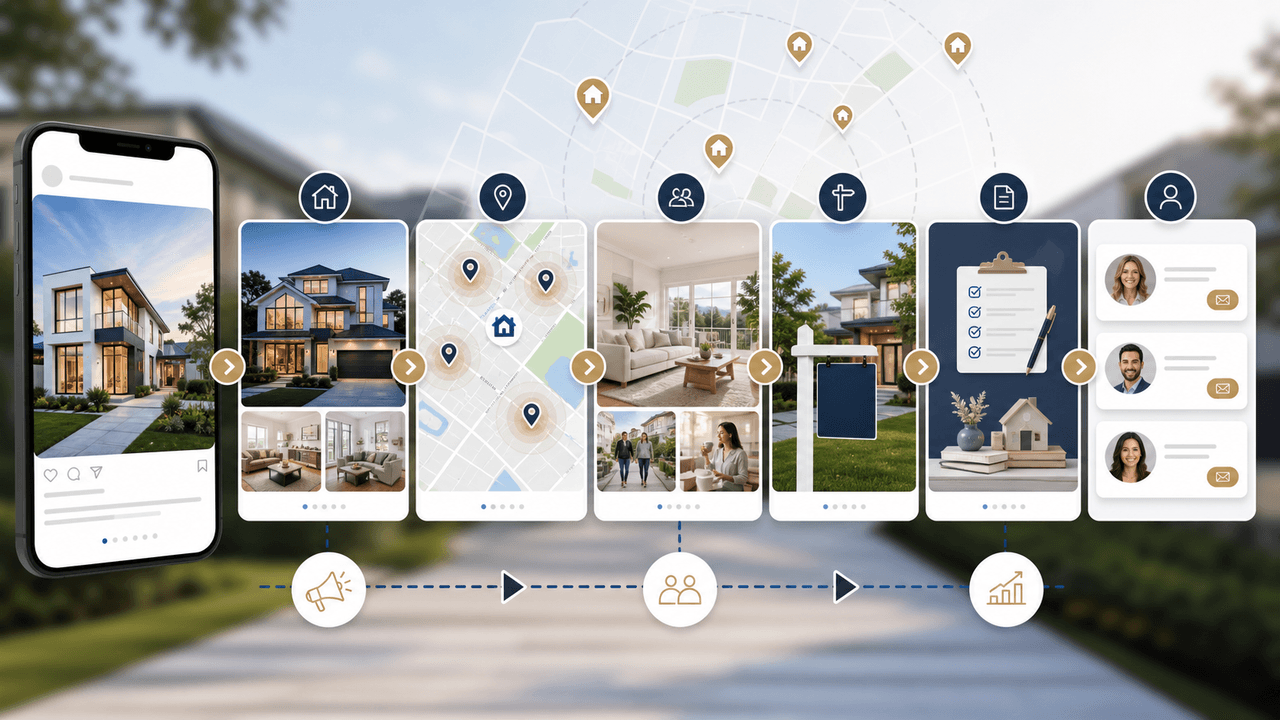
Real estate carousel marketing works best as a documented publishing process: verify authority and facts, describe the property rather than a preferred resident, disclose the professional source, and give every slide one useful job.
Sources
- Advertising and Marketing — U.S. Department of Housing and Urban Development
- Fair Housing — National Association of REALTORS
- Social Media Best Practices for Real Estate Professionals — National Association of REALTORS
- Create & manage posts on your Business Profile — Google Business Profile Help
- Tips for business-specific photos on your Business Profile — Google Business Profile Help
Written by
AttentionClaw
Editorial Team
Editorial context
Part of the Content Planning topic cluster. Last updated June 22, 2026.