Chapter 1
A course case study should explain change
A student win is not automatically a good social post. The useful part is the change: what the student was trying to do, what was difficult, what action they took, and what became possible.
For course creators, that means the case study should support decision-making without promising that every student will get the same result.
The strongest assets combine proof with education. They show how the method works in the real world.
Chapter 2
Get permission and define boundaries
Before repurposing a student story, confirm what can be shared: name, image, business, numbers, screenshots, quotes, and sensitive details.
The FTC's testimonial and endorsement guidance is relevant because course proof content can influence buying decisions. Claims should be truthful, contextual, and not misleading.
If a result is atypical, say so. If a screenshot contains private information, remove it or do not use it.
Before a case study becomes public content, confirm the approved name, photo, quote, numbers, screenshots, business context, and expiration date for permission. Store that approval next to the draft so future repurposing does not rely on memory.
A case study sequence should also separate proof from promotion. First explain the starting point, then the action, then the result, then the caveat, and only then the course CTA.
Chapter 3
Use a seven-part case study map
- 1
Starting point
What was the student trying to improve before the course?
- 2
Constraint
What made the problem difficult or urgent?
- 3
Course intervention
Which lesson, framework, feedback, or template helped?
- 4
Student action
What did the student actually do?
- 5
Result
What changed, and how is it measured?
- 6
Caveat
What context prevents the post from overpromising?
- 7
Next step
What should a similar reader do next?
Chapter 4
Turn one case study into multiple assets
A before-after carousel with context and caveats.
A quote post with the student's approved words.
A process breakdown that teaches the framework.
A FAQ post answering the objection the student had.
A sales-page proof block for the course page.
A newsletter story that expands the lesson.
Chapter 5
Avoid result hype
Result hype weakens trust. A course creator does not need to make every student story sound like a miracle.
Google's people-first content guidance is a useful editorial filter: the case study should help the reader understand whether the method is a fit.
A grounded case study often converts better than an inflated one because it makes the mechanism visible.
A useful phrasing pattern is 'here is what changed after this student applied X in Y context,' not 'this course guarantees Z.' The first version explains cause, action, and fit. The second version invites skepticism.
Course proof content should also say what the student brought to the result: prior experience, time invested, market conditions, support used, or constraints. Context makes the story more credible.
Chapter 6
Make proof posts readable and accessible
Case study screenshots can be hard to read on mobile. Summarize the key point in text rather than relying on the screenshot alone.
WCAG guidance on text alternatives is a useful reminder: important non-text content needs a text equivalent. Captions, alt text, and slide copy should carry the meaning of the proof.
This also helps social assets travel across platforms where image display and cropping differ.
Chapter 7
Measure proof content by fit, not only reach
Course case study content should drive qualified interest: saves, replies, course-page clicks, application starts, waitlist joins, and questions about the method.
Use UTM-tagged links when case study posts point to a course page or consultation form. Track the case study theme, not only the platform.
If a post gets reach but low-fit leads, the result may be exciting but the course fit is unclear.
The best measurement question is whether the case study attracts people who recognize the same starting point. A smaller post that brings qualified replies can be more valuable than a viral post that attracts people outside the course's promise.
Use those replies to decide what the next proof asset should explain: the prerequisite, the module, the support format, or the next action for someone with the same blocker.
Chapter 8
Where AttentionClaw fits
AttentionClaw fits after the course creator has permission, approved claims, and the seven-part case study map. It can turn that material into carousels, captions, FAQs, and sales-page support.
The result is a proof system that teaches why the course works instead of repeating vague testimonials.
Callout
Turn student wins into specific proof content
Use AttentionClaw to turn student wins into specific, ethical social content that explains the method behind the result.
Chapter 9
Before-and-After Framing That Builds Trust Without Overpromising
The most durable case study framing is not 'look what my student achieved' — it is 'here is what changed and why.' The before state needs to be specific enough to be recognizable: a student who was spending twelve hours a week on a task they could not systematize is more relatable than a student who 'struggled.' The after state needs to be honest about what changed and what remains ongoing — completed transformations that sound frictionless are less believable than accounts that include a setback or a learning curve.
A practical test for whether a case study post is built on durable framing: could a prospective student read it and recognize their own situation in the before? Could they read the after and believe it plausibly describes their own trajectory? If the before is too vague or the after is too polished, the post loses its specificity — which is where its value lives.
Courses with strong community elements often produce the best case studies because students articulate their progress in discussion threads or coaching calls in conversational, specific language. That raw language — lightly edited with permission — tends to outperform polish-heavy testimonials because it sounds like a real person describing a real experience.
Chapter 10
Matching Case Study Format to Funnel Stage
Not every case study post serves the same purpose in a content funnel. A top-of-funnel case study post should focus on problem recognition — the before state, the specific frustration, the reason the student started looking for a solution. This post does not need to mention the course prominently. It earns attention from people who share that frustration. A mid-funnel case study post should focus on the decision process — what the student evaluated, why they chose this approach, and what gave them confidence to commit.
Bottom-of-funnel case study content is where specific outcomes, timelines, and process details belong. This is the content that prospective buyers in consideration mode will save, revisit, and share with a partner or advisor. It should be your most complete and most specific — the student's starting point, the modules or strategies that made the most difference, the timeline, and any honest caveat about what the student brought to the experience that contributed to their result.
Running case study content across all three funnel stages from a single student story is one of the most efficient content operations available to a course creator. One interview or testimonial form, properly structured, can generate six to eight assets that serve different audiences at different points in their decision-making process.
Top of funnel: emphasize the recognizable problem, not the solution
Middle of funnel: highlight the decision and the evaluation process
Bottom of funnel: include specific process, timeline, and honest caveats
Retargeting: use the most specific outcome slide as a standalone post or story
Next step
Turn student wins into proof content
AttentionClaw helps course creators convert case studies into carousels, captions, FAQs, and course-page support.
Common Questions
FAQ
More Reading
Keep reading
11-chapter read
Course Waitlist Launch Instagram Carousels
Course waitlist launch carousels should explain who the course is for, what the waitlist gives people, what results are not guaranteed, and when enrollment opens.
9-chapter read
Course Cohort Launch Instagram Carousels: Sell the Group Experience Without Overpromising
Course cohort launch carousels should explain who the cohort is for, what the schedule includes, how support works, what proof is available, and what enrollment deadline matters.
9-chapter read
Tutoring Center Progress Update Carousels: Show Learning Without Overpromising
Tutoring progress carousels should help parents understand learning goals, practice routines, assessment checkpoints, and next steps without exposing student privacy or promising guaranteed outcomes.

How to Turn One Good Idea Into 7 Different Instagram Carousels
You do not need 30 unique ideas to post every day. You need one strong idea and a system that turns it into 7 carousels with different angles, formats, and depths.
10-chapter read
How to Turn a Case Study Into Social Content That Teaches
A case study becomes social content when you separate the starting problem, constraints, intervention, proof, lesson, caveat, and next step into assets that teach rather than merely celebrate the result.
11-chapter read
How to Turn Cohort Course Feedback Into Content and Better Lessons
Cohort course feedback becomes useful content when you separate student blockers, assignment patterns, live questions, transformation moments, and curriculum gaps into safe, anonymized assets.
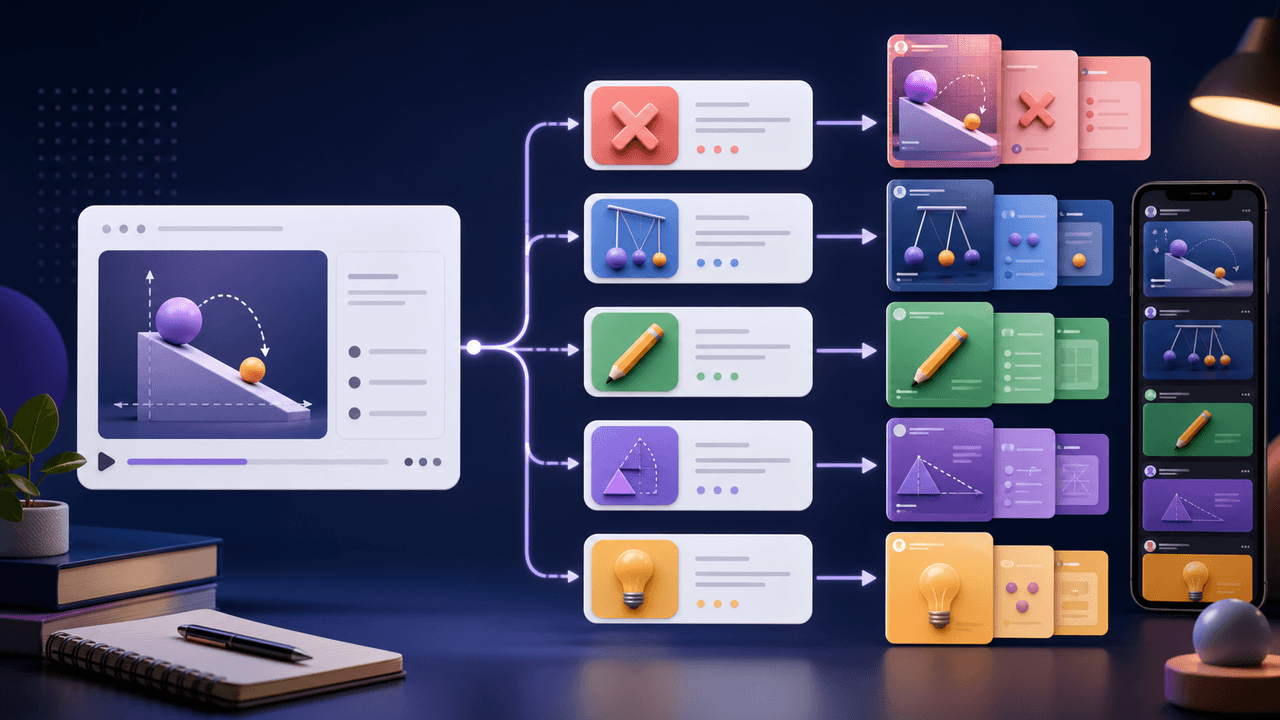
How to Turn One Course Lesson Into Social Posts That Still Teach
One course lesson can become a full social content cluster when you extract the learning objective, misconception, demonstration, practice prompt, and transformation proof instead of summarizing the lesson.

Coaching Business Carousel Strategy: Get Clients From Instagram Without Feeling Salesy
Most coaches post carousels that get likes but never convert to discovery calls. This strategy fixes that by aligning every carousel to a specific stage in your client's decision journey.

Client Transformation Carousels: The Before-After Framework That Sells Coaching
Client transformation carousels are the highest-converting content a coach can post. This framework shows you how to tell client stories in a way that builds trust, demonstrates results, and attracts ideal prospects.

Turn coach-owned source material into useful carousel briefs
A practical workflow for turning coach-owned long-form material into standalone carousel briefs without inventing a guaranteed output count or exposing client information.
Sources
- Endorsements, Influencers, and Reviews — Federal Trade Commission
- Creating Helpful, Reliable, People-First Content — Google Search Central
- Web Content Accessibility Guidelines 2.1 — W3C
- URL Builders: Collect Campaign Data With Custom URLs — Google Analytics Help
Written by
AttentionClaw
Editorial Team
Editorial context
Part of the Repurposing topic cluster. Last updated June 22, 2026.