Chapter 1
Interview prep is already content research
Podcast hosts, YouTubers, newsletter writers, and expert creators often spend hours preparing for interviews. They research the guest, read past work, write questions, collect links, and decide the angle. Most of that work disappears after recording.
That is wasteful. Prep notes contain audience education, context, question prompts, and objection angles. They can become content before and after the interview, as long as the creator separates public context from private research.
Google's people-first content guidance is useful because prep-derived content should help the audience understand why the conversation matters. The goal is not hype. It is orientation.
Guest research becomes context posts.
Question themes become audience polls.
Past work becomes resource notes.
Audience objections become follow-up posts.
Interview angle becomes the launch hook.
Chapter 2
Build a five-part interview prep map
- 1
Guest authority
What makes the guest credible for this topic? Capture public facts, not private assumptions.
- 2
Audience relevance
Why should your audience care about this guest now? Connect the guest's expertise to a current reader or viewer problem.
- 3
Question themes
Group questions into themes such as origin story, method, mistake, case example, caveat, and next step.
- 4
Resource notes
Collect articles, tools, books, examples, or frameworks mentioned in prep. These can become newsletter links or document notes.
- 5
Content hypothesis
Predict which angle will produce the best clip, carousel, newsletter, and CTA after the interview.
Chapter 3
Use prep notes for pre-show content
Pre-show content should not reveal the whole conversation before it happens. It should frame the question the audience wants answered. Use guest research to explain why the topic matters and use polls to collect audience input.
YouTube posts can include polls, quizzes, text, images, and video. That makes them useful before an interview: ask what viewers want the guest to answer, or test which subtopic matters most.
Pre-show posts also improve the interview itself. Audience questions can sharpen your prompts and make the final episode more relevant.
Guest context post: why this person is relevant.
Audience poll: which question should be asked.
Resource teaser: one public link or idea from prep.
Angle post: the problem the interview will address.
Chapter 4
Convert the prep map into launch assets
After recording, compare the prep map to the actual conversation. Which hypothesis was right? Which answer surprised you? Which question produced the strongest framework?
Launch assets should combine prep context with interview substance. The carousel can explain the guest's method. The newsletter can explain why the conversation changed your view. The guest-share post can highlight the expert's strongest answer.
Apple Podcasts marketing tools and podcast metadata guidance are useful for baseline episode promotion, but custom assets should go beyond title and cover art. They should show why the episode is worth attention.
Chapter 5
Build a two-week interview content calendar
A single strong interview can support a two-week calendar. Before launch, publish context and audience input. On launch, publish the promise and guest asset. After launch, publish the framework, story, objection, and resource notes.
This sequence prevents the interview from becoming one announcement. It gives the audience multiple reasons to care: relevance, method, proof, discussion, and next step.
For expert businesses, the follow-up assets are often more valuable than the launch post because they make the conversation useful to people who will never listen to the whole episode.
- 1
Days -5 to -2
Publish audience poll, guest context, and topic teaser.
- 2
Launch day
Publish the episode or video announcement with a clear promise and tagged guest asset.
- 3
Days 2-5
Publish method carousel, quote post, and newsletter note.
- 4
Days 6-10
Publish objection post, resource roundup, and CTA asset.
Chapter 6
Turn expert interviews into documents when the prep is deep
If the prep includes source notes, guest frameworks, and market context, consider a LinkedIn-style document after the interview. LinkedIn Document Ads guidance shows how documents can be shared in feed and used for lead generation in paid contexts. Organic creators can use the same format as a saveable brief.
The document should not be a transcript. It should be a field guide based on the interview: context, question, framework, example, caveat, and next action.
This is especially useful for B2B creators and expert businesses where the audience wants substance before clicking through.
Chapter 7
Measure prep-derived assets as one interview campaign
Measure pre-show, launch, and follow-up assets separately. Pre-show polls measure demand. Launch assets measure attention. Follow-up assets measure usefulness and conversion.
Google Analytics URL builder guidance explains that campaign parameters identify referral campaigns. Use one campaign name for the interview and content labels such as pre_poll, guest_context, launch_post, method_carousel, resource_newsletter, and interview_cta.
After the sequence, update your interview prep template. If audience polls produce better questions, make them mandatory. If resource roundups drive clicks, collect better resource notes before each interview.
Chapter 8
Where AttentionClaw fits
AttentionClaw fits after the interview prep map is created. The host chooses the guest context, question theme, framework, and CTA. AttentionClaw can then turn those into branded social assets for before and after launch.
This turns interview preparation into a production system rather than a private document that disappears after recording.
Callout
Turn interview research into launch-ready content assets
Use AttentionClaw to turn interview research and question themes into launch-ready carousels, posts, and follow-up assets.
Chapter 9
Turning Interview Disagreements and Surprising Answers Into Standalone Content
The most engaging moments in a creator interview are often the ones that did not go according to the prep notes: a guest who pushed back on the host's framing, an answer that contradicted conventional wisdom in the niche, or a moment where both host and guest arrived at a shared conclusion that neither had expected. These moments are gold for post-interview content because they carry genuine intellectual tension — which is what makes content shareable rather than merely informative.
During prep, note the hypotheses you are testing with each question. After the interview, flag the two or three moments where the answer surprised you. These become the basis for 'I asked X and got an answer I didn't expect' posts — a format that is honest, specific, and naturally prompts engagement from people who either agree or disagree with the surprising position.
This approach also gives the host content that differentiates the interview from a standard Q&A. If every post from the interview is a summary of what was said, the content is informational but not memorable. The moments where something unexpected happened are the ones that make the interview feel like an event worth following.
Chapter 10
Building a Guest Cross-Promotion Plan Into the Prep Calendar
Interview prep calendars often stop at the host's content plan. A more complete system includes a brief cross-promotion structure: one or two assets that the guest can post with minimal effort, formatted for the guest's audience rather than the host's. This is often a missed opportunity — a guest with a large or loyal audience who reposts a well-framed asset from the interview can drive more traffic to the episode than the host's own promotional content.
The prep stage is the right time to align on this, not the post-production stage. During prep, the host can ask the guest one or two questions specifically designed to generate a quotable standalone moment that would resonate with the guest's audience. That intention shapes the recording in a way that post-production editing cannot fully replicate. A guest who knows a specific moment will be turned into a cross-post asset is more likely to deliver a crisp, quotable version of their thinking.
A simple cross-promotion plan might include: one quote card formatted for the guest's primary platform, one summary slide from the guest's perspective on the conversation's main insight, and a short email the host can send the guest with the assets and suggested caption copy. The total production cost is low; the distribution benefit can be significant.
Callout
Build the guest's asset at their audience's level, not yours
The guest's followers may not know who you are yet. Design the cross-post asset to introduce the conversation through the guest's perspective and expertise — not as a promotion of your show. This makes the asset genuinely useful for the guest to post and more credible to their audience.
Next step
Turn interview prep into a complete content sequence
AttentionClaw helps turn guest research and interview themes into branded pre-show, launch, and follow-up assets.
Common Questions
FAQ
More Reading
Keep reading
10-chapter read
How to Turn an Educator Syllabus Into a Content Calendar
An educator syllabus can become a content calendar when each week is mapped to the learner question, misconception, example, practice prompt, proof asset, and next-step CTA.
10-chapter read
How to Turn a Creator Swipe File Into Original Content
A creator swipe file becomes a content system when you tag saved examples by hook, structure, proof, audience problem, visual pattern, and CTA, then rebuild the mechanics with your own source material.

6 Instagram Carousel Hook Formulas That Actually Stop the Scroll
Your carousel is only as good as its first slide. These 6 hook families give you a rotation system that keeps your openings sharp without ever running out of ideas.
A 30-Day Calendar That Includes the Work Around Each Post
A useful monthly Instagram calendar records more than publication dates. It connects audience questions, approved sources, content pillars, owners, review gates, destinations, live URLs, listening notes, and correction decisions. The complete 30-day example below includes production and hold days so it can be adapted without implying that every account should post daily.
Choose Content Pillars Your Team Can Actually Support
An Instagram content pillar is a durable editorial promise to a defined audience, supported by evidence your team can keep producing. It is not a mandatory posting ratio, a list of formats, or an SEO topic cluster. Use the worksheet in this guide to decide which themes deserve recurring coverage and which should remain occasional.
Build Instagram carousels around a measurable next step
A carousel cannot guarantee conversion. It can make one next step clear, give the reader enough evidence to evaluate it, and produce a testable signal. This guide shows how to design and measure that system.
10-chapter read
How to Turn Audience Survey Results Into a Content Calendar
Audience survey results become a content calendar when you sort answers by pain, desired outcome, objection, language, and next-step intent, then map each group to a useful content format.
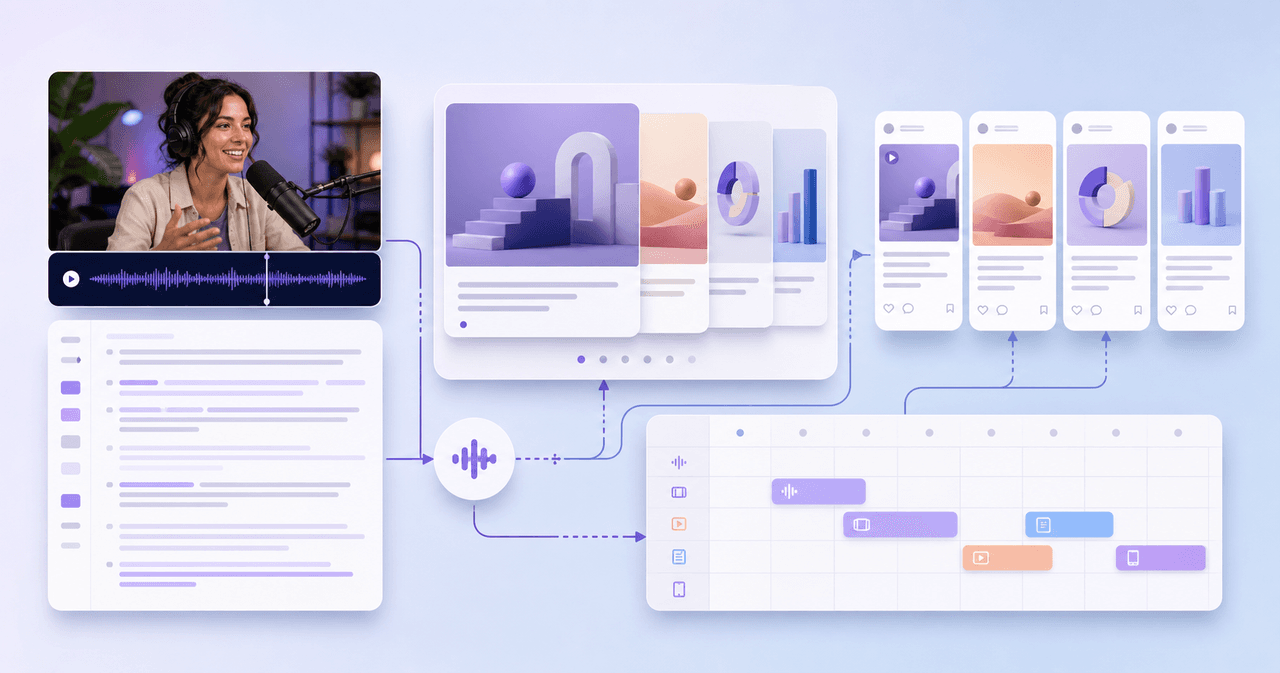
Podcast Interview Content Repurposing System: One Guest Conversation Into a Week of Assets
A podcast interview should become more than audiograms. Extract the guest thesis, strongest story, quotable lines, objection answers, listener questions, and resource CTA into a week of native assets.
Turn coach-owned source material into useful carousel briefs
A practical workflow for turning coach-owned long-form material into standalone carousel briefs without inventing a guaranteed output count or exposing client information.
Sources
- Creating Helpful, Reliable, People-First Content — Google Search Central
- Learn About Posts — YouTube Help
- Apple Podcasts Marketing Tools — Apple Podcasts for Creators
- Document Ads — LinkedIn Marketing Solutions
- URL Builders: Collect Campaign Data With Custom URLs — Google Analytics Help
Written by
AttentionClaw
Editorial Team
Editorial context
Part of the Content Planning topic cluster. Last updated June 22, 2026.