Chapter 1
The direct answer: show sponsor-fit proof
A creator brand deal media kit Instagram carousel should show audience niche, content formats, partnership categories, performance signals, past examples, usage-rights boundaries, disclosure standards, and the sponsor inquiry CTA.
FTC endorsement guidance matters because brand relationships and material connections must be disclosed clearly. The carousel should make the creator look professional, not vague about paid promotion.
The goal is not to publish every rate or private metric. It is to prove fit and route serious brands to the full media kit or inquiry form.
Callout
Creator content rule
Show enough proof to qualify sponsors while keeping rates, terms, and private analytics in the inquiry flow.
Chapter 2
Answer what a sponsor needs before reaching out
Sponsors want to know who the creator reaches, what the creator can make, whether the audience trusts them, what categories fit, and how the partnership process works.
A carousel can answer those questions without becoming a full contract. Use ranges, examples, and inquiry routing.
If the creator uses testimonials from brands, performance claims, or revenue claims, the wording should be accurate and supportable.
Audience niche and buyer context.
Content formats offered.
Example campaign categories.
Proof points and case-study signals.
Disclosure and brand-safety standards.
Inquiry form or email CTA.
Chapter 3
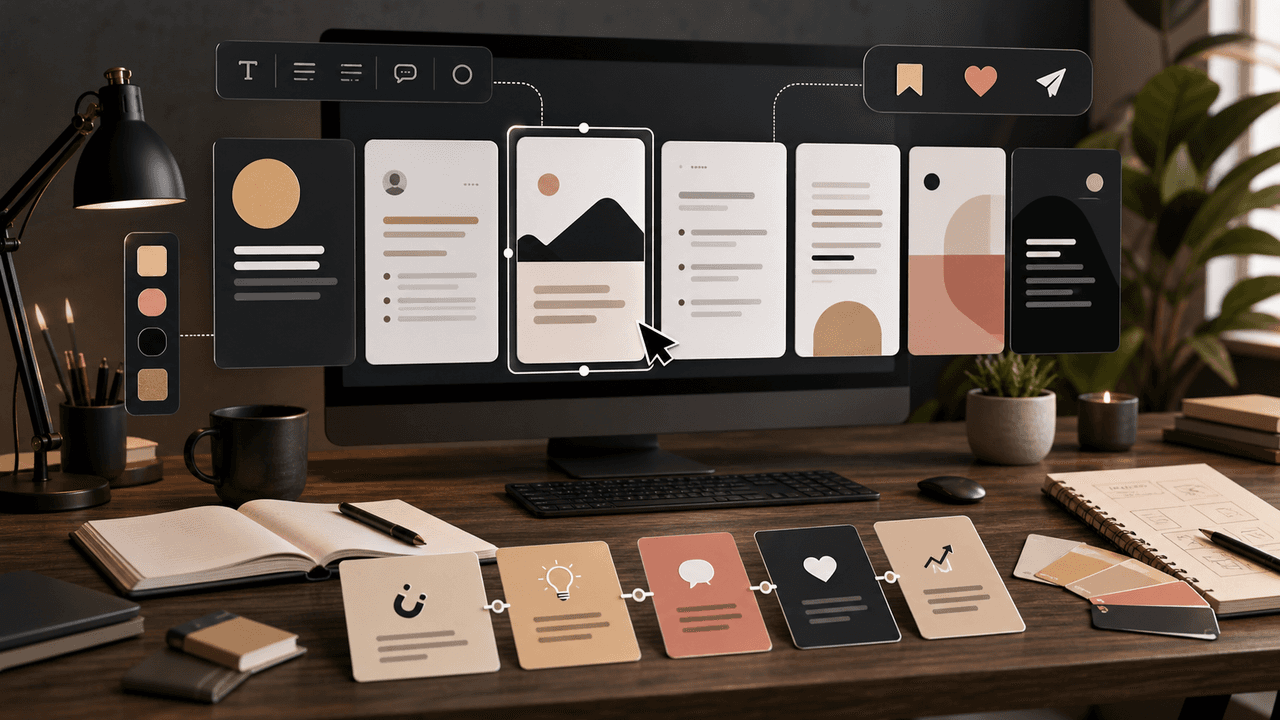
Use a seven-slide media kit preview
Use screenshots of public work, anonymized campaign snapshots, and clean audience summaries.
Do not publish private campaign terms or brand data without permission.
- 1
Slide 1: partnership hook
Name the creator's niche and the sponsor problem.
- 2
Slide 2: audience
Explain audience segments, interests, and buyer relevance.
- 3
Slide 3: formats
Show reels, carousels, newsletters, lives, UGC, or product demos.
- 4
Slide 4: proof
Share accurate performance or qualitative proof.
- 5
Slide 5: fit
List sponsor categories that match the audience.
- 6
Slide 6: process
Explain inquiry, brief, approval, posting, and reporting steps.
- 7
Slide 7: CTA
Invite brands to request the media kit or partnership form.
Chapter 4
Set disclosure, proof, and usage-rights guardrails
FTC endorsement guidance says endorsements should be honest and not misleading, and material connections should be clear. A media kit carousel should signal that the creator understands disclosure requirements.
Usage rights, whitelisting, exclusivity, and category conflicts should not be improvised in comments. Route those questions to the inquiry process.
Performance proof should be real, recent enough to be useful, and labeled with context.
Disclose sponsored examples where relevant.
Do not exaggerate audience size or results.
Keep usage rights in the deal process.
Do not share private brand data without permission.
Use a clear partnership inquiry path.
Chapter 5
How AttentionClaw helps creators package sponsor proof
AttentionClaw can turn a creator's media kit, top posts, audience notes, sponsor examples, and disclosure rules into Instagram carousels.
Creators can build variants for product sponsors, local sponsors, newsletter sponsors, affiliate programs, launch partners, and event collaborations.
The creator controls rates and deal terms. AttentionClaw keeps the public-facing content polished and inquiry-focused.
Callout
Creator workflow
Collect proof, choose sponsor category, review claims and disclosures, publish a media kit preview with a partnership CTA.
Chapter 6
Measure sponsor inquiry quality
Measure partnership inquiries, media kit downloads, sponsor-category fit, response rate, deal value, and time saved answering basic questions.
If inquiries are unqualified, sharpen the audience and sponsor-fit slides before adding more proof.
Sponsor inquiry form completions.
Media kit requests.
Qualified sponsor categories.
Deal close rate.
Questions answered before outreach.
Chapter 7
What sponsors actually evaluate when they look at a media kit carousel
A sponsor reviewing a creator's media kit carousel is asking three questions in sequence: does this creator reach the people I am trying to reach, does their audience actually pay attention to what they post, and can this creator produce something that feels native enough that my brand does not look like an interruption. The media kit carousel that converts answers all three in the first three slides — before the sponsor has to ask.
Audience size is less decisive than many creators believe. A sponsor for a specialty cooking equipment brand cares more about the overlap between a creator's audience and cooking-enthusiast buyers than about raw follower count. A carousel that leads with niche specificity — 'My audience is home cooks who build out their kitchen intentionally' — is more useful to a relevant sponsor than one that leads with a follower number that provides no context.
Engagement quality matters more than engagement rate as a standalone number, but engagement rate is still the shorthand most sponsors use as a first filter. If the rate is strong, name it and contextualize it. If the rate is modest but the comments are substantive and the audience demographic is precisely matched, a dedicated slide explaining the engagement pattern — with a screenshot or two as evidence — can reframe a number that might otherwise disqualify the creator in a quick scan.
Chapter 8
How to differentiate a media kit carousel from every other creator's deck
Most media kit carousels look similar: follower count, engagement rate, audience demographics, a content sample, and a 'work with me' CTA. The creator who stands out is the one who leads with a specific, memorable audience insight rather than a statistics summary.
One approach: open the carousel with a short description of a day in the life of your typical audience member — not as a generic persona, but as a concrete behavior pattern you have observed. 'My audience checks this feed during their lunch break. They are mid-career professionals who have thirty minutes to research a purchase decision and trust my recommendations because I explain my reasoning.' That description tells a sponsor something they could not read from a follower count.
Another differentiator is the partnership origin story. If you have worked with brands before, one slide that briefly explains how you approached the integration — why you chose to feature the product a certain way, what you said no to — signals editorial judgment. Sponsors are not only buying reach; they are buying a creative collaborator with standards. Demonstrating that you have those standards proactively is more persuasive than claiming to have them in a bio.
- 1
Open with your audience's defining characteristic
Replace the generic demographic summary with one sentence about what your audience does or cares about that no other creator's audience does in quite the same way.
- 2
Show one partnership example with context
Instead of a screenshot gallery, describe one past integration and explain what made it work. What did the audience respond to? What would you do differently? This shows judgment, not just reach.
- 3
Name your categories and your non-categories
Tell sponsors what you work with and what you decline. A creator who says 'I work with kitchen and food brands, not supplements or weight-loss products' signals editorial integrity and saves both parties time.
Chapter 9
When to update and re-post the media kit carousel
A media kit carousel has a shelf life. Follower counts and engagement benchmarks shift, past campaign results age, and audience demographics evolve. A carousel that was accurate six months ago may now misrepresent the creator's reach or niche focus. Outdated media kit content can create friction during deal negotiations if the sponsor's expectations were set by numbers that no longer apply.
Treat the media kit carousel as a living document with a quarterly review cadence. At minimum, update the carousel when a significant audience milestone is reached, after a successful campaign that adds a strong proof point, or when the creator pivots to a new content focus. The re-post is also a content opportunity — a brief caption explaining what has changed signals to sponsors that the creator is active and growing.
For creators who post the media kit carousel publicly, consider creating two versions: a public-facing preview carousel for Instagram that focuses on audience insight and content approach, and a private PDF or slide deck with specific campaign metrics for sponsors who have already expressed interest. The carousel opens the conversation; the detailed kit closes it.
Next step
Turn creator proof into sponsor-ready content
AttentionClaw helps creators package audience proof, partnership examples, and disclosure-aware messaging into Instagram carousels that attract better sponsor inquiries.
Common Questions
FAQ
More Reading
Keep reading
8-chapter read
Podcast Sponsor Media Kit Instagram Carousels
Podcast sponsor media kit carousels should package audience fit, inventory, measurement, disclosure expectations, and advertiser next steps without inflating download claims.
8-chapter read
Creator Paid Membership Launch Instagram Carousels
Creator paid membership launch carousels should explain who the membership is for, what members get, what is not included, launch timing, pricing clarity, and disclosure boundaries.
9-chapter read
Substack Newsletter Instagram Carousels: Turn Essays Into Subscriber Teasers
Substack newsletter carousels should turn one essay into a subscriber-focused sequence: premise, tension, key idea, proof, takeaway, and subscription CTA.
7-chapter read
Photographer Image Usage Social Content: Explain Rights, Credit, and Sharing
Photographer image usage posts help clients understand copyright, sharing permission, credit, gallery downloads, print rights, vendor tagging, and testimonial disclosure. The best posts protect the photographer's work while making client sharing feel easy and respectful.
10-chapter read
How to Turn a Creator Media Kit Into Social Content
A creator media kit can become sponsor-attracting social content when its audience promise, proof, brand fit, formats, and collaboration examples are translated into useful public posts.
10-chapter read
How to Turn Newsletter Sponsorships Into Social Content
Newsletter sponsorships can become useful social content when the public assets explain the audience problem, disclose the relationship clearly, and point readers to the sponsor offer without copying the email ad verbatim.

B2B Carousel Content That Generates Leads (Not Just Impressions)
Most B2B carousels generate impressions but zero leads because they are built for engagement, not conversion. This guide shows you how to design every slide with lead generation as the end goal.

Thought Leadership Carousels for Consultants: Position Yourself as the Expert
Consultants sell expertise, and Instagram carousels are the best format for demonstrating it at scale. This guide gives you the hooks, structures, and content system to build thought leadership that attracts high-value clients without dumbing down your insights.
Write carousel copy as one connected argument
Good carousel copy lets a reader understand one argument without guessing what connects the slides. This guide covers hooks, claim-proof editing, continuity, legibility, and a complete before-and-after example.
Sources
- The FTC's Endorsement Guides: What People Are Asking — Federal Trade Commission
- FTC Policy Statement Regarding Advertising Substantiation — Federal Trade Commission
- About Carousel Ads — Meta Business Help Center
- Creative best practices for performance ads — TikTok Business Help Center
Written by
AttentionClaw
Editorial Team
Editorial context
Part of the Carousel Creation topic cluster. Last updated June 22, 2026.