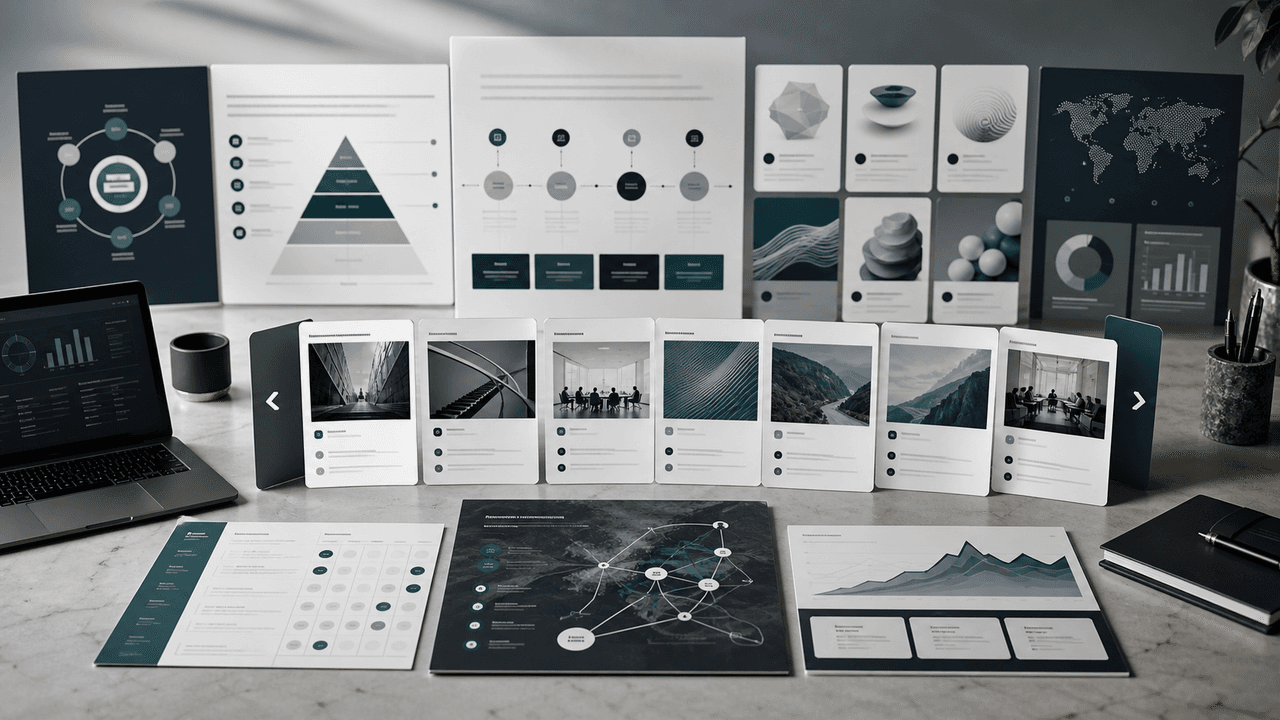
Chapter 1
Why serious consultants are building audiences on Instagram
The consulting industry has a visibility problem. The best consultants are often the least visible because they are busy doing client work. Meanwhile, less experienced competitors are building audiences that generate inbound leads, speaking invitations, and premium positioning — all from a consistent Instagram presence.
Instagram carousels are the consultants' secret weapon because they reward depth. While LinkedIn favors opinions and hot takes, Instagram carousels let you walk someone through a complete analytical framework in 10 slides. That format matches how consultants think and communicate: structured, evidence-based, and methodical.
The decision-makers who hire consultants — CEOs, VPs, founders — are on Instagram. They may not engage with business content the way they do on LinkedIn, but they notice it. When a consultant's carousel appears between personal photos and Reels, it stands out precisely because it is substantive. That pattern interrupt is worth more than blending into a LinkedIn feed full of similar content.
Instagram carousels reward the structured, analytical thinking consultants already do
Decision-makers scroll Instagram daily — your content reaches them in a low-guard environment
The format contrast between entertainment and expertise makes consulting carousels stand out
Thought leadership on Instagram is still underutilized by consultants, creating a first-mover advantage
Carousels have the longest shelf life of any Instagram format — they generate saves for months after posting
Chapter 2
The 4 pillars of consultant thought leadership on Instagram
Thought leadership is not about having opinions. It is about consistently demonstrating a quality of thinking that makes people trust your judgment on complex problems.
- 1
Pillar 1: Diagnostic Expertise
Show your audience how you see problems they cannot see themselves. Name hidden patterns, diagnose root causes, and reveal the dynamics beneath surface symptoms. When a potential client reads your diagnostic carousel and thinks 'that is exactly what is happening in my business,' you have earned their attention.
- 2
Pillar 2: Framework Thinking
Share the mental models and frameworks you use to analyze situations. Consultants are paid for structured thinking, and carousels are the ideal format for displaying it. A well-presented framework teaches the audience to think in your categories, which means they start seeing their problems through your lens.
- 3
Pillar 3: Pattern Recognition
Demonstrate that you have seen enough situations to recognize patterns that others miss. 'After working with 40 B2B SaaS companies, here is the growth pattern I see repeated.' Patterns from experience cannot be replicated by someone who has only read about your domain.
- 4
Pillar 4: Contrarian Credibility
Challenge conventional wisdom in your field with well-reasoned alternatives. This is the highest-risk, highest-reward pillar. When you take a defensible contrarian position and back it with evidence, you differentiate yourself from every other consultant who echoes the same industry consensus.
Chapter 3
Hook formulas that attract decision-makers, not just followers
The hooks that work for lifestyle and personal brand content do not work for consultants. Your audience is sophisticated, skeptical, and time-poor. They will not swipe on vague promises or emotional manipulation. They swipe on intellectual intrigue — the feeling that the next slide contains an insight they cannot afford to miss.
The best consulting hooks create what I call an 'expertise gap.' They reveal just enough about a pattern or insight to make the reader realize they are missing something important. The reader swipes not because they are curious about a trick — they swipe because they are concerned about a blind spot.
- 1
The Pattern Hook
'After advising 30 [industry] companies, I keep seeing the same mistake at the [revenue level] stage.' This signals experience depth and implies a valuable insight. Decision-makers who are at that revenue level feel compelled to check.
- 2
The Reframe Hook
'The problem with your [function] is not what you think it is.' This challenges the reader's current diagnosis and offers a new perspective. Executives who are frustrated by a persistent problem will swipe to see the alternative explanation.
- 3
The Data Hook
'We analyzed [X] companies and found that [surprising finding].' Data-driven hooks are irresistible to analytical decision-makers. The finding must be genuinely surprising — confirming what everyone already believes is not a hook.
- 4
The Framework Hook
'The [named framework] that separates [good result] companies from [bad result] companies.' Named frameworks signal structured thinking and promise a transferable mental model. Decision-makers collect useful frameworks.
- 5
The Contrarian Hook
'Stop [popular practice]. It is costing [industry] companies $X per year.' Leading with a specific, quantified contrarian claim demands attention. The reader needs to evaluate whether the claim applies to them.
Callout
The credibility test
Before publishing any hook, ask: would I say this in a boardroom presentation? If the hook feels too casual, sensational, or vague for a professional context, it is wrong for a consulting audience. Your hooks should sound like the opening line of a compelling conference keynote.
Chapter 4
5 carousel structures that demonstrate consulting-grade thinking
The structure of your carousel is where your consulting expertise becomes visible. Anyone can share tips. A consultant shares structured analysis. The difference is in how you organize and present information.
- 1
The Diagnostic Carousel
Present a problem your target clients face and walk through your diagnostic process. Each slide peels back another layer: surface symptoms, underlying causes, hidden dynamics, root cause, and recommended approach. This mirrors how you work with clients and demonstrates the value of your analytical process.
- 2
The Framework Carousel
Introduce a proprietary framework with a visual model on slide 2, then dedicate one slide to each component. Close with how the framework applies to a real situation. Name every framework. Named frameworks are intellectually ownable and become associated with you.
- 3
The Industry Analysis Carousel
Break down a trend, shift, or development in your industry. Slide 1 names the change. Slides 2-4 explain the drivers. Slides 5-7 cover the implications. Slides 8-9 recommend strategic responses. This positions you as someone who monitors and interprets industry dynamics.
- 4
The Case Study Carousel
Walk through a client engagement (anonymized if needed) using the situation-approach-result structure. Emphasize the diagnostic insight that led to the solution, not just the solution itself. The quality of your thinking is what sells, not the outcome alone.
- 5
The Comparison Carousel
Compare two approaches, strategies, or models side by side. 'Traditional approach vs. [your approach]' with specific differences highlighted across 6-8 dimensions. This format lets you position your methodology against the default without being overtly promotional.
Chapter 5
Writing for a sophisticated audience without dumbing it down
The biggest tension for consultants on Instagram is the perceived need to simplify. You worry that your insights are too complex for a social media audience. But dumbing down your expertise undermines the entire purpose of thought leadership. The solution is to be clear, not simple.
Clarity and simplicity are different things. Simplicity strips away nuance. Clarity preserves nuance while making it accessible. You can discuss complex market dynamics, organizational behavior, or strategic trade-offs in carousel format as long as each slide makes one clear point that builds on the previous one.
Use concrete examples instead of abstract theory. Instead of 'organizations should align incentive structures with strategic objectives,' write 'when your sales team is bonused on revenue but your strategy requires margin growth, you get exactly the wrong behavior.' The insight is equally sophisticated but the delivery is concrete and immediately recognizable.
Be clear, not simple — preserve the nuance that makes your thinking valuable
One idea per slide is the golden rule for complex topics
Replace abstract concepts with concrete examples your audience has experienced
Use industry-specific language your target audience already knows — do not over-explain jargon they use daily
If a concept requires background the audience may not have, add a brief context slide before diving in
Chapter 6
Writing captions that extend the conversation beyond the carousel
For consultants, the caption is not an afterthought — it is where the most valuable engagement happens. The carousel presents your thinking. The caption invites dialogue. And dialogue is where consulting relationships begin.
The best consulting captions add personal context that the carousel format cannot easily convey. Share why you chose this topic, what prompted the insight, or how your thinking on this subject has evolved over time. This turns a polished piece of analysis into a conversation with a real person who has real experience.
End every caption with a genuine question. Not a rhetorical one — a real question that invites your audience to share their perspective. The responses become market intelligence, potential client conversations, and relationship-building opportunities.
- 1
The Context Caption
'I originally developed this framework after a client's $2M initiative failed because of [specific reason]. It changed how I think about [topic].' Personal context adds the human dimension that makes your expertise relatable.
- 2
The Extension Caption
'The carousel covers the framework, but here is what I could not fit in 10 slides: [additional nuance, caveat, or application].' This rewards people who read the caption and demonstrates even more depth.
- 3
The Dialogue Caption
'I have seen this pattern in [industry A] and [industry B], but I am curious — is anyone seeing it in [industry C]? Drop your observations below.' This positions you as curious and collaborative, not just authoritative.
- 4
The Stakes Caption
'Getting this wrong costs most companies 6-12 months and a significant amount of credibility with their board. Here is how to get it right the first time.' Captions that quantify the stakes create urgency without being pushy.
Chapter 7
Building a thought leadership content pipeline from your consulting work
The best consulting thought leadership comes directly from real client engagements. Every project you work on contains insights that your broader audience would find valuable. The challenge is creating a system to capture and publish those insights without violating client confidentiality.
The approach is to extract patterns rather than details. You never share client-specific information. You share the patterns you observe across multiple engagements. 'After working on three digital transformation projects this quarter, I noticed that all three shared the same bottleneck' reveals a pattern without exposing any client.
Build a content capture habit. After every client meeting, workshop, or deliverable, spend five minutes writing down the one insight that would be most valuable to your audience. Over a month, those five-minute captures produce 15-20 carousel topics.
- 1
After every client engagement: pattern capture
Write down one pattern, insight, or counterintuitive finding from the engagement. Keep it general enough to protect confidentiality. This is your raw thought leadership material.
- 2
Weekly: industry monitoring
Spend 30 minutes reviewing industry developments, competitor moves, and market data. Note anything that connects to your expertise or contradicts conventional wisdom. These become industry analysis carousels.
- 3
Monthly: framework development
Review your accumulated patterns and insights. Can any of them be organized into a new framework? New frameworks are the highest-value content you can produce because they are original intellectual property.
- 4
Quarterly: content performance review
Analyze which carousels generated the most saves, shares, and DMs. Double down on the topics and formats that resonate. Retire the ones that underperform.
Chapter 8
The consultant's carousel production system
You bill by the hour and your hours are valuable. The production system needs to be efficient enough that it does not compete with client work for your time.
The most sustainable approach for consultants is a weekly batch session of 90 minutes that produces three to four carousels. This is enough to maintain a consistent posting schedule without cutting into billable time.
Separate the thinking from the production. Throughout the week, capture ideas in a running note. On your batch day, the ideas are already formed — you just need to structure them into carousels and design the slides. This separation is the reason the 90-minute session works.
- 1
Minutes 0-15: Select and outline
Choose 3-4 topics from your content bank. Assign each a carousel structure (diagnostic, framework, analysis, case study, or comparison). Write a quick slide-by-slide outline for each.
- 2
Minutes 15-50: Write all copy
Draft the full slide text for all carousels. Work through them sequentially. Use your natural consulting language — clear, precise, and analytical. Do not try to sound like a social media marketer.
- 3
Minutes 50-75: Design
Apply your brand templates or use AttentionClaw to generate the visual slides. Consulting carousels should look clean, professional, and data-rich. Avoid trendy design — go for timeless professionalism.
- 4
Minutes 75-90: Captions and scheduling
Write captions for each carousel using one of the caption formulas. Schedule the posts across the week. Review one final time for accuracy — factual errors in consulting content are brand-damaging.
Chapter 9
The visual identity that signals consulting-grade expertise
Your carousel design should signal 'this person works with serious organizations.' Clean typography, muted or sophisticated color palettes, data visualization elements, and generous white space. Think McKinsey slide deck aesthetics adapted for a mobile screen.
Avoid the design trends that dominate consumer-facing Instagram content — bold neon gradients, hand-drawn elements, and playful fonts. These signal creativity, which is valuable for some brands, but for consultants they can undermine the perception of rigor and seriousness.
Include data visualization elements wherever possible. Charts, diagrams, process flows, and comparison tables are native to consulting communication and instantly signal analytical depth. Even a simple 2x2 matrix on one slide tells the audience this is structured thinking, not casual opinion.
Use a sophisticated color palette — navy, charcoal, slate blue, or muted earth tones
Choose serif or clean sans-serif fonts that read as professional, not trendy
Include data visualizations — charts, diagrams, matrices, and process flows
Generous white space signals confidence and clarity
Consistent slide layouts across all carousels build recognition and trust
Use AttentionClaw to lock in your professional visual identity and produce consistent carousels without starting from a blank canvas each time
Chapter 10
Converting carousel engagement into consulting conversations
Thought leadership without a conversion mechanism is just intellectual charity. Your carousels need to create pathways from audience engagement to business conversations. The key is subtlety — consulting buyers are repelled by aggressive sales tactics.
The most effective conversion path for consultants is the expertise-to-conversation funnel. Your carousels demonstrate expertise. Your caption invites dialogue. The dialogue moves to DMs. The DM conversation reveals a need. The need leads to a discovery call. Each step feels natural because it is driven by genuine intellectual exchange.
Make it easy for prospects to take the next step without making it feel transactional. Your bio should clearly state what you do and include a link to a consultation booking page. Your carousel CTAs should feel like natural extensions of the content, not sales pitches.
Your bio should clearly state your consulting focus and include a booking link
End carousels with CTAs that invite conversation: 'Facing this challenge? I advise companies through exactly this transition'
When someone engages meaningfully with your content in comments, follow up in DMs with genuine curiosity
Share a free diagnostic tool or assessment as a lead magnet — consultants convert through diagnosis, not discounts
Track which carousel topics generate the most DMs and booking clicks — these are your highest-converting content themes
Next step
Build thought leadership carousels in minutes
AttentionClaw generates professional, brand-consistent carousels from your consulting insights. Define your visual identity once, produce authority-building content at the pace your practice demands.
Common Questions
FAQ
More Reading
Keep reading
9-chapter read
Personal Training Lead Social Content: Posts That Turn Fitness Interest Into Consults
Personal training lead content should help prospects understand assessment, goals, safety, consistency, coaching fit, and how to book a consultation. The best posts are specific, realistic, evidence-aware, and careful with transformation claims.
8-chapter read
Carousel Slide Order That Converts: Hook, Proof, Offer, CTA
A converting carousel usually follows a clear order: hook, context, problem, solution or product, proof, objection handling, offer, and CTA. The exact slide count can change, but the reader should never wonder why the next slide exists.

How to Write App Comparison Carousels That Win Users From Competitors
Comparison carousels are the most direct way to win users from competitors. This guide covers hooks, slide structures, and ethical framing techniques that position your app as the obvious choice without sounding desperate or dishonest.
B2B Carousel Content That Generates Leads (Not Just Impressions)
Most B2B carousels generate impressions but zero leads because they are built for engagement, not conversion. This guide shows you how to design every slide with lead generation as the end goal.
Turn one SaaS decision into a useful LinkedIn document
A SaaS LinkedIn carousel strategy should treat the format as a native document post: build one useful professional argument, assemble and verify the document before upload, and measure it with LinkedIn's available post analytics rather than a promised cadence or lead formula.
Coaching Business Carousel Strategy: Get Clients From Instagram Without Feeling Salesy
Most coaches post carousels that get likes but never convert to discovery calls. This strategy fixes that by aligning every carousel to a specific stage in your client's decision journey.

Client Transformation Carousels: The Before-After Framework That Sells Coaching
Client transformation carousels are the highest-converting content a coach can post. This framework shows you how to tell client stories in a way that builds trust, demonstrates results, and attracts ideal prospects.

Build a Personal Brand With Instagram Carousels: The Authority System
Personal branding on Instagram is not about being everywhere. It is about being unmistakable. This system uses carousels to build authority, memorability, and trust so that when your audience needs what you offer, you are the only name that comes to mind.

High-Ticket Offer Funnels Using Instagram Carousels: From Free Value to $5K Clients
High-ticket clients do not buy from a single post. They buy after experiencing a sequence of content that builds belief, addresses objections, and makes the investment feel inevitable. This guide shows you how to engineer that sequence using Instagram carousels.

Write carousel copy as one connected argument
Good carousel copy lets a reader understand one argument without guessing what connects the slides. This guide covers hooks, claim-proof editing, continuity, legibility, and a complete before-and-after example.
Written by
AttentionClaw
Editorial Team
Editorial context
Part of the Hooks & Captions topic cluster. Last updated June 22, 2026.