Chapter 1
Why carousels outperform workout videos for client acquisition
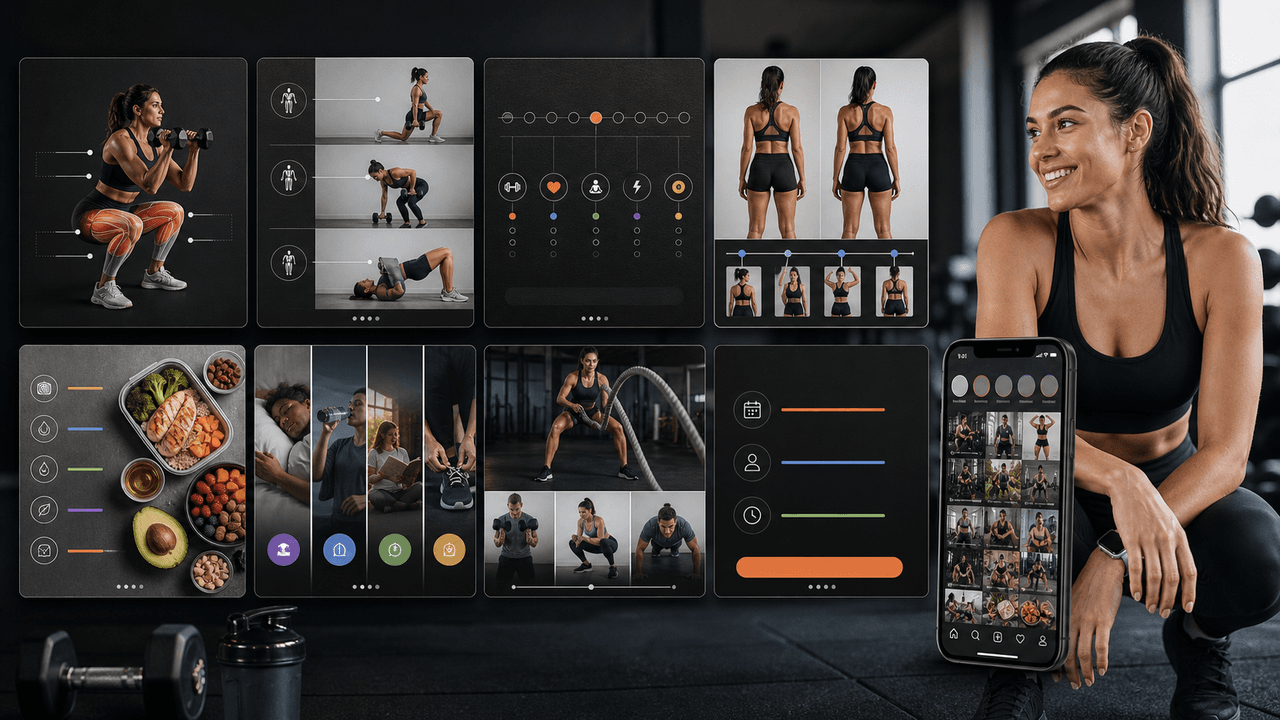
Workout videos are entertaining but they rarely convert viewers into clients. Someone can watch your workout Reel, try the exercises at home, and never think about hiring you. Carousels work differently because they educate — and education creates the realization that the viewer needs professional guidance.
When you post a carousel explaining why someone's knee pain during squats is caused by ankle mobility limitations, you are not just sharing information. You are demonstrating diagnostic expertise that the viewer cannot replicate on their own. That gap between 'I understand the problem' and 'I need help solving it' is where client acquisition happens.
The data supports this. Fitness carousels tend to earn notably higher save rates than Reels because people bookmark them as reference material. Each save is a future revisit, and each revisit reinforces your authority. Over time, the person who saves five of your carousels thinks of you first when they decide to invest in training.
Workout videos entertain but carousels educate — education drives client decisions
Carousels demonstrate diagnostic expertise that videos cannot convey as effectively
Save rates on fitness carousels tend to run higher than on Reels
Saved carousels become an ongoing reference library that keeps you top of mind
Educational content positions you as a coach, not just a workout provider
Chapter 2
The 5 carousel content types every fitness trainer needs
A strategic mix of content types ensures you attract, educate, and convert your ideal clients on a consistent basis.
- 1
Exercise Education Carousels
Break down a single exercise across 8-10 slides: the correct form, common mistakes, muscles targeted, variations for different levels, and when to include it in a program. These are your most saveable content because they serve as a training reference.
- 2
Myth-Busting Carousels
Challenge common fitness misconceptions. 'Why crunches will not give you visible abs' or 'The truth about eating after 8PM.' These generate high engagement because fitness myths are emotionally charged and widely believed.
- 3
Program Design Carousels
Share the thinking behind effective programming. How to structure a training week, how to progress over 8 weeks, how to balance strength and cardio. This demonstrates the expertise that separates a qualified trainer from a workout video on YouTube.
- 4
Nutrition Education Carousels
Cover practical nutrition guidance without being prescriptive. Meal prep strategies, understanding macros, pre and post-workout nutrition, and common dietary mistakes. Nutrition content is consistently the highest-performing category for fitness accounts.
- 5
Client Transformation Carousels
Share client success stories with their permission. Before-and-after photos, training journey timelines, and specific details about what the program involved. These are your most conversion-heavy content because they provide proof that your training delivers results.
Chapter 3
How to structure a workout carousel that people actually save and use
The most common workout carousel mistake is cramming an entire workout into a carousel with no context. Listing exercises with sets and reps gives people a workout but it does not build trust or demonstrate expertise. A well-structured workout carousel teaches the why behind the programming.
The best workout carousels follow a structure that educates while it instructs. The hook slide names the goal. The next slide explains why this approach works for that goal. The exercise slides show each movement with form cues. The final slide explains how to progress and when to advance.
- 1
Slide 1: The Hook — name the goal
'The 20-minute upper body workout that builds visible shoulders.' Be specific about the outcome. Generic workout names do not stop the scroll.
- 2
Slide 2: The Why — explain the programming logic
'This workout uses compound-to-isolation sequencing to maximize time under tension in 20 minutes.' One slide of context separates you from every other trainer posting random exercise lists.
- 3
Slides 3-8: The Exercises — show and instruct
One exercise per slide. Include the exercise name, sets and reps, one key form cue, and a photo or illustration. Keep text minimal and scannable.
- 4
Slide 9: Progression guidance
'Do this workout 2x per week for 4 weeks. When you can complete all sets with the prescribed rest, increase weight by 5-10%.' This ongoing guidance makes the carousel a reusable resource.
- 5
Slide 10: CTA
'Want a full 8-week program designed for your goals? DM me PROGRAM or book a free consultation — link in bio.' Connect the free value to your paid service.
Chapter 4
Creating nutrition carousels that educate without being prescriptive
Nutrition content is a goldmine for fitness trainers but it comes with a responsibility to stay within your scope of practice. You can educate about general nutrition principles without providing individualized meal plans or medical nutrition advice. The line is important both ethically and legally.
The safest and most effective approach is to focus on practical, everyday nutrition decisions. Meal prep tips, grocery shopping strategies, understanding food labels, and debunking common myths. This content is universally valuable and does not cross into clinical territory.
Nutrition carousels perform exceptionally well because everyone eats. Your workout content reaches people who exercise. Your nutrition content reaches everyone. This makes it your best top-of-funnel content for attracting new followers who later convert into training clients.
- 1
The Meal Prep Carousel
Walk through a practical meal prep session. Show 3-4 meals that can be prepared in one batch session, with approximate macros and total time required. These are among the most saved fitness carousels because they solve an immediate, recurring problem.
- 2
The Food Comparison Carousel
Compare similar foods side by side. '100 calories of almonds vs. 100 calories of Greek yogurt — which keeps you fuller?' Visual comparisons are engaging and educational without being prescriptive.
- 3
The Common Mistakes Carousel
'5 nutrition mistakes that are stalling your fat loss.' Address the most frequent errors you see in your clients without calling anyone out. This creates self-awareness that often leads to inquiring about your services.
- 4
The Practical Tips Carousel
Share actionable, low-barrier tips. 'How to add 30g of protein to any meal without cooking.' Practicality is what makes nutrition content shareable — people send these to friends who are trying to eat better.
Chapter 5
The fitness transformation carousel that books consultations
Before-and-after photos are the most traditional form of fitness marketing, but a carousel lets you tell the full story instead of just showing two photos. The story is what separates a compelling transformation from a flat comparison that viewers scroll past.
The most effective fitness transformation carousels combine visual evidence with narrative context. How long did the transformation take? What was the training approach? What were the biggest challenges? What did the client learn about themselves? The answers to these questions create an emotional connection that photos alone cannot.
- 1
Slide 1: The result headline
'How Maria lost 25 lbs and gained the confidence to run her first 5K — in 16 weeks.' Lead with the outcome that your ideal client wants.
- 2
Slide 2: The before — context and struggles
Describe where the client started, including their challenges, fears, and what they had tried before. This creates recognition in prospects who are in a similar position.
- 3
Slides 3-5: The approach — what you did together
Share 2-3 key elements of the training and nutrition approach. Enough detail to demonstrate your methodology without giving away the entire program. This is where you show your expertise.
- 4
Slides 6-7: The challenges and breakthroughs
Honest moments from the journey. A plateau that required a program adjustment. A mindset shift that unlocked progress. These details make the story believable and relatable.
- 5
Slides 8-9: The after — results with specifics
Before and after photos (with permission), key metrics, and the client's own words about their experience. Include both physical and lifestyle outcomes.
- 6
Slide 10: CTA
'Ready to start your own transformation? Book a free consultation — link in bio. Or DM me TRANSFORM to learn more about my 12-week program.'
Chapter 6
Hook formulas that stop fitness audiences mid-scroll
Fitness audiences scroll past hundreds of workout posts daily. Your hook needs to break the pattern by offering something they have not seen before — a new perspective, a surprising claim, or a direct challenge to something they believe.
The most effective fitness hooks combine specificity with an emotional trigger. Vague hooks like 'great ab workout' are invisible. Specific hooks like 'the ab exercise that trainers do but never post about' create curiosity that demands a swipe.
'Stop doing [popular exercise] — here is what to do instead' (contrarian)
'I gave my client this one exercise and her [pain point] disappeared in 2 weeks' (result)
'Why you are not seeing results even though you train 5x a week' (diagnostic)
'The exercise most trainers skip that builds [muscle group] fastest' (insider knowledge)
'Everything you know about [fitness topic] is wrong' (myth-buster)
'This 4-move workout builds more muscle than an hour at the gym' (efficiency promise)
'If your [body part] hurts during [exercise], you are making this mistake' (problem-solution)
Callout
The specificity rule
The more specific your hook, the fewer people it attracts — but those people are far more likely to save, share, and eventually book. 'Shoulder workout' attracts everyone. 'The overhead press fix for people with desk-job posture' attracts exactly the person who needs a trainer.
Chapter 7
Adapting your carousel strategy for local vs. online training
The carousel strategy differs significantly depending on whether you are filling in-person classes at a specific location or booking online training clients nationwide. The content pillars are the same, but the targeting, CTAs, and proof points change.
For local trainers, carousels should include location-specific hooks and CTAs. 'The best workout for Austin's summer heat' or 'Join our 6 AM class in Brooklyn — 3 spots left this week.' Geographic specificity filters for the people who can actually walk through your door.
For online trainers, carousels should emphasize the convenience and customization of remote coaching. Address the common objection that online training is less effective by showing your communication tools, check-in processes, and program customization. Proof carousels should feature clients from different locations to demonstrate that the approach works regardless of geography.
Local trainers: Include your city or neighborhood in hooks and hashtags
Local trainers: CTA should drive to a free class trial or in-person consultation
Online trainers: Address the skepticism about remote coaching directly in your content
Online trainers: Show your tech stack — app screenshots, check-in examples, video form reviews
Both: Client transformation carousels are equally effective for local and online conversion
Chapter 8
Designing fitness carousels that look professional without a designer
Fitness is a visual industry, which means your carousels compete against highly produced content from brands with design teams. But you do not need a designer to create professional-looking carousels. You need a consistent visual system and the discipline to use it.
The most effective fitness carousel design uses high-contrast typography over clean backgrounds. Exercise demonstration photos should be well-lit and uncluttered. Text should be large enough to read in the feed without tapping. And your brand colors should appear on every slide so your carousels are recognizable at a glance.
Consistency is more important than polish. A feed full of consistently designed carousels with the same fonts, colors, and layout style looks more professional than a feed of individually designed masterpieces that do not match each other.
Use 2-3 brand colors consistently across every carousel
Choose one heading font and one body font — do not change them
Exercise photos should be well-lit, clear, and taken against a clean background
Keep text large and scannable — fitness carousels are often read while at the gym
Use tools like AttentionClaw to maintain brand consistency across all your carousels without spending time on design decisions
Chapter 9
The weekly posting schedule that builds a fitness training pipeline
Consistency in posting is non-negotiable for fitness trainers because your audience makes training decisions on weekly cycles. Someone scrolling Instagram on Sunday evening is planning their workout week. If your content is there with a workout carousel, a nutrition tip, and a transformation story, you are top of mind when they decide to book.
The optimal schedule for most fitness trainers is four carousels per week. More is sustainable only if you batch produce. Less makes it hard to maintain visibility in the algorithm.
- 1
Monday: Exercise Education
Start the week by teaching something. An exercise breakdown, a form correction, or a programming principle. Monday audiences are in learning mode and planning their training week.
- 2
Wednesday: Nutrition or Myth-Busting
Mid-week content that appeals to a broader audience. Nutrition carousels and myth-busters attract people who are not yet your followers but are interested in fitness.
- 3
Friday: Workout Carousel
Give your audience something to do over the weekend. A complete workout carousel they can save and use. Friday workout posts see the highest save rates of the week.
- 4
Sunday: Client Transformation or Program Spotlight
Close the week with proof or an offer. Transformation stories and program details perform well on Sunday when people are reflecting on their goals and planning ahead.
Chapter 10
Tracking which carousels actually drive training inquiries
The only metric that matters for a fitness trainer's Instagram is inquiries — DMs, consultation bookings, and class sign-ups. Everything else is a leading indicator at best and a vanity metric at worst.
Track which carousel types and topics generate the most inquiries. You may discover that nutrition carousels drive more DMs than workout carousels, or that transformation stories generate more consultation bookings than any other content type. These patterns should inform your content mix.
Create a simple tracking system. When someone DMs you or books a consultation, ask how they found you and which content stood out. Over three months, you will have clear data showing which carousels are your best sales tools. Double down on those formats and topics.
Track DMs and consultation bookings by the carousel that triggered them
Ask every new client how they found you and which content they remember
Save rates indicate content quality — high saves mean people are referencing your carousels
Share rates indicate reach potential — high shares mean your content resonates enough for endorsement
Monitor which carousel types drive the most profile visits — these are your strongest top-of-funnel content
Review monthly and adjust your content mix based on what actually drives business, not what gets the most likes
Next step
Create fitness carousels that fill your classes
AttentionClaw generates professional Instagram carousels and TikTok slideshows for fitness trainers. Define your brand, describe your content, get publish-ready slides in minutes.
Common Questions
FAQ
More Reading
Keep reading
9-chapter read
Personal Trainer Assessment TikTok Slideshows
Personal trainer assessment TikTok slideshows should explain goals, movement history, readiness, safety boundaries, program fit, and how to book a consultation without promising results.
9-chapter read
Dance Studio Trial Class Instagram Carousels: Help New Students Show Up
Dance studio trial class carousels should help new students and parents understand what to wear, what to bring, class level, expectations, privacy, and how to book.
9-chapter read
Gym Intro Offer TikTok Slideshows: Sell Trial Weeks Without Overpromising Results
Gym intro-offer TikTok slideshows should explain who the trial is for, what happens during the first week, how coaches scale workouts, and how to join without promising body transformations.
9-chapter read
Personal Training Lead Social Content: Posts That Turn Fitness Interest Into Consults
Personal training lead content should help prospects understand assessment, goals, safety, consistency, coaching fit, and how to book a consultation. The best posts are specific, realistic, evidence-aware, and careful with transformation claims.
9-chapter read
Yoga Studio Class Pass TikTok Slideshows: Sell the First Visit
Yoga studio slideshows should reduce first-visit anxiety: what class to choose, what to bring, who teaches it, what the room feels like, and how the intro pass works. The right content sells comfort and clarity, not just poses.
7-chapter read
Gym Challenge Launch Social Content: Fill Signups Without Overpromising Results
Gym challenge content should sell structure, community, and consistency rather than guaranteed transformation. Use readiness posts, weekly prompts, safety-aware guidance, honest testimonials, and clear signup CTAs to fill challenges with better-fit participants.
8-chapter read
Gym Class Social Content Calendar: Fill Classes With Local Posts
A gym class content calendar should sell confidence before it sells intensity. Use class previews, beginner guidance, trainer education, member proof, seasonal challenges, and local booking reminders to turn social attention into trial classes and repeat attendance.

Client Transformation Carousels: The Before-After Framework That Sells Coaching
Client transformation carousels are the highest-converting content a coach can post. This framework shows you how to tell client stories in a way that builds trust, demonstrates results, and attracts ideal prospects.

Write carousel copy as one connected argument
Good carousel copy lets a reader understand one argument without guessing what connects the slides. This guide covers hooks, claim-proof editing, continuity, legibility, and a complete before-and-after example.
Carousel Design Principles: The Visual Rules That Get More Swipes
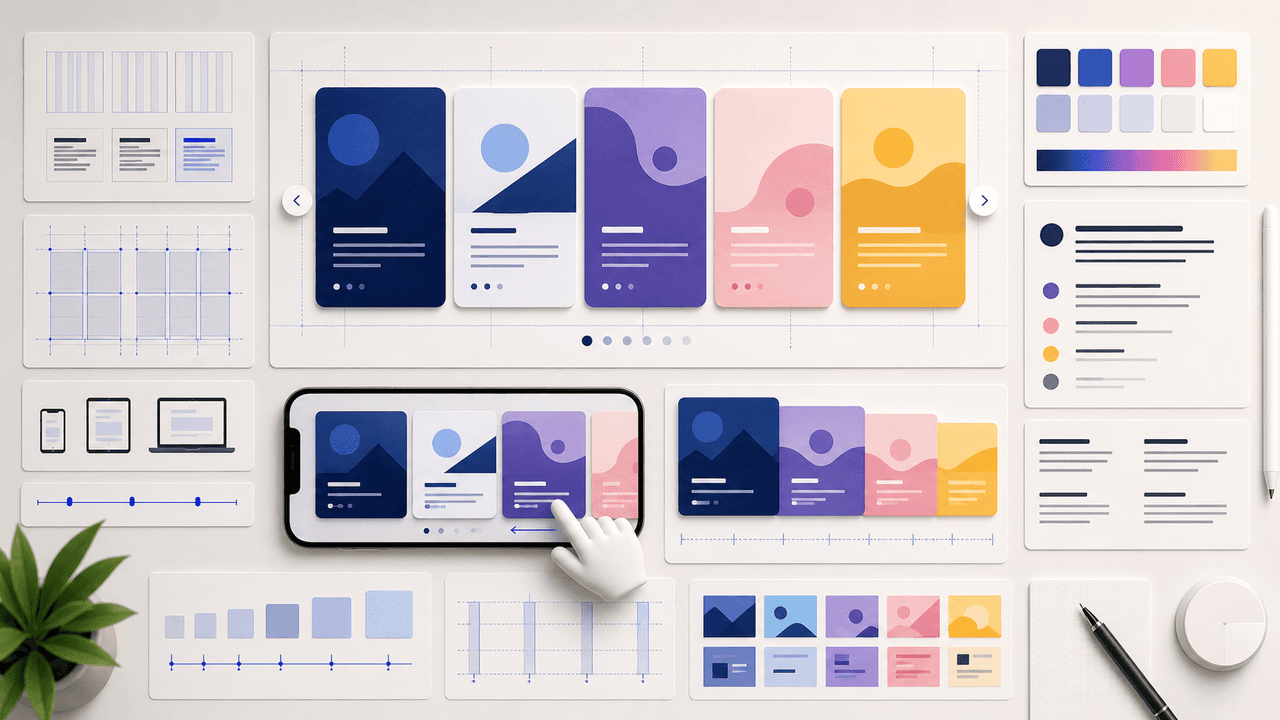
Great carousel design is not about being a graphic designer. It is about following a set of visual rules that make your content readable, recognizable, and swipeable. This guide breaks down each rule with concrete specifications you can apply immediately.
Written by
AttentionClaw
Editorial Team
Editorial context
Part of the Carousel Creation topic cluster. Last updated June 22, 2026.